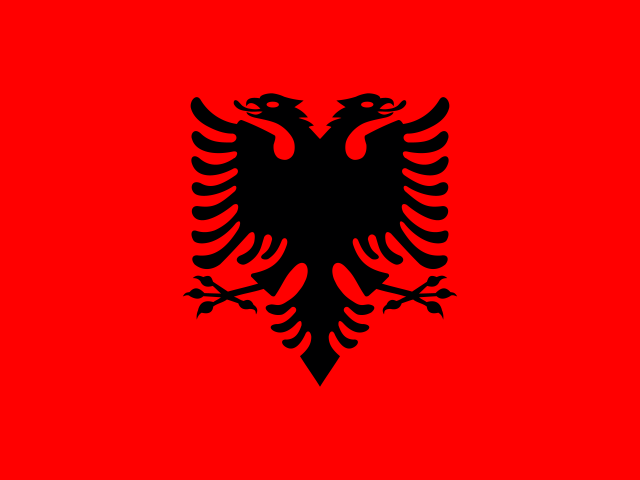
 Albania
Comprehensive education database information
Education System in Albania
Albania, situated on the Balkan Peninsula, is bordered by the Adriatic Sea to the west, Serbia and Montenegro to the north, North Macedonia to the east, and Greece to the south and southeast. Following decades of authoritarian rule under Enver Hoxha from 1946 until 1985, Albania underwent significant reforms beginning in 1991 with the establishment of its first non-Communist government. The education system has been shaped by historical challenges, including the impact of the Communist regime, which emphasized literacy and accessibility, and later crises that disrupted educational operations. Today, Albania continues to address various challenges as it seeks to enhance its educational framework.
Overview of the Education System
Albania's education system is organized into several distinct levels: Primary Education, Secondary Education, Vocational Education, and Tertiary Education. The country boasts a literacy rate of approximately 99%, indicating ongoing commitment to high educational standards.
Primary Education
- Duration: Primary education spans 9 years, preceded by a non-mandatory preschool phase.
- Compulsory Education: Education is compulsory for the initial 9 grades.
- Continuation: After primary education, most students proceed to complete grade 12.
- Academic Year: The academic calendar is divided into two semesters, starting in September/October and ending in June/July.
Secondary Education
- Duration: Secondary education extends for an additional 3 years beyond primary schooling.
- Focus: The curriculum is designed to provide academic instruction, preparing students for higher education.
- Infrastructure: Recent investments have led to the reconstruction of many secondary schools, which are now being equipped with modern technologies.
Vocational Education
- Alternative Pathway: Vocational education provides an alternative to traditional schooling.
- Duration: Vocational programs typically last between 2 to 5 years, depending on whether students seek a basic diploma or a complete trade qualification.
- Economic Impact: The government has prioritized the development of vocational education, recognizing its importance in supporting a growing economy.
Tertiary Education
- Universities: Albania hosts a variety of both public and private universities, widely distributed across major urban centers.
- University of Tirana: Established in 1957, the University of Tirana is the country's first university, currently serving nearly 15,000 students and employing approximately 900 faculty members.
- Faculties: The university offers a broad spectrum of faculties, including:
- Economic Sciences
- Foreign Languages
- History & Philology
- Medicine
- Natural Sciences
- Law
- Social Sciences
- Physical Education
- Reputation: The University of Tirana is gaining an international reputation for quality education, reflecting the improvements made in the higher education sector.
In conclusion, the education system in Albania has evolved significantly over the years, facing numerous challenges while striving to improve literacy and educational quality. With ongoing reforms and investments, the country is working towards a more robust and effective educational framework to meet the needs of its population.