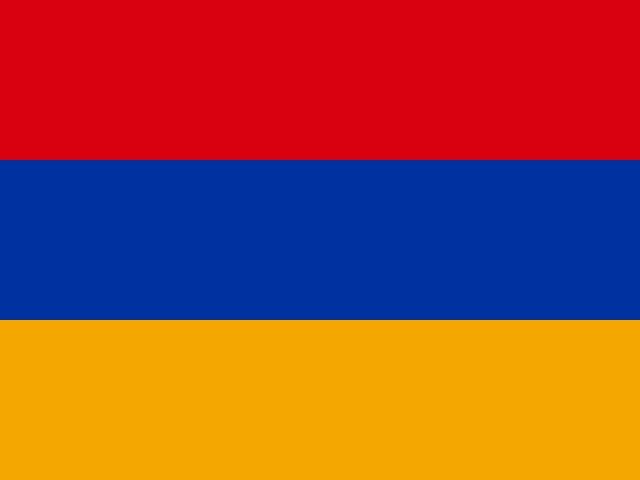
 Armenia
Comprehensive education database information
Education System in Armenia
Overview of Armenia
The Republic of Armenia, known as Hayastani Hanrapetut'yun, is a landlocked nation situated in southwestern Asia, bordered by Georgia, Turkey, Azerbaijan, and Iran. With a population of approximately 2.97 million, the country is predominantly comprised of ethnic Armenians, with minorities including Kurds and Russians. Armenia boasts an impressive literacy rate of 99.4%. The official language is Armenian, which is also the primary language of instruction in schools, while Russian remains a significant second language due to historical influences.
Armenia's rich history dates back to the Bronze Age, and it is recognized as the first country to adopt Christianity as a state religion in 301 AD. The nation has experienced various invasions and dominations throughout its history, including periods under the Assyrians, Greeks, Romans, and Ottomans. After a tumultuous 20th century marked by Soviet rule, Armenia declared its independence from the Soviet Union on September 21, 1991. The country has a profound educational legacy, with reforms established in 1999 aimed at modernizing its education system to align more closely with Western models.
Education System Overview
The educational framework in Armenia is designed to foster continuous learning from early childhood through higher education. The system comprises several levels, including primary, secondary, vocational, and tertiary education.
Primary Education
Early Childhood Education
Education begins at the pre-school level, which emphasizes the physical, moral, and cognitive development of children. Families are actively involved in this early developmental phase, laying a strong foundation for future learning.
Primary School
Following pre-school, children enter primary school, which lasts for three years. During this time, students acquire essential knowledge about society, technology, and nature, establishing a basis for further education.
Middle Education
Intermediate School
Students then progress to grades 4 through 9, typically until they reach the age of 14. This stage of education is known as intermediate schooling.
Curriculum
The curriculum during these years is academically rigorous and culminates in the awarding of a certificate of basic education to those who successfully complete the program.
Secondary Education
Continuation
Secondary education in Armenia extends for an additional two years beyond the intermediate level.
Certification
Upon completion of secondary schooling, students receive a certificate for full secondary education, which is essential for accessing both vocational training and higher education opportunities.
Vocational Education
Armenia offers two distinct levels of vocational training:
- Level One: This level focuses on equipping students with practical job skills necessary for entry-level employment.
- Level Two: This level provides specialized training in technical fields and can last up to four years, leading to formal qualifications.
Tertiary Education
Armenia is home to a variety of public and private universities that offer both undergraduate and graduate programs. Among the most prestigious institutions are:
- American University of Armenia
- Yerevan State University: Established in 1919, it is the oldest university in the country with 110 departments and a workforce of over 3,000, including approximately 1,200 professional staff supporting nearly 10,000 students.
- Urartu University
These universities contribute significantly to the academic landscape of Armenia, providing diverse educational opportunities and fostering higher learning.
Conclusion
The education system in Armenia reflects a commitment to fostering academic excellence and personal development at all stages of life. From early childhood education through to tertiary studies, Armenia's approach emphasizes quality education, accessibility, and alignment with global standards, preparing students for both local and international challenges.