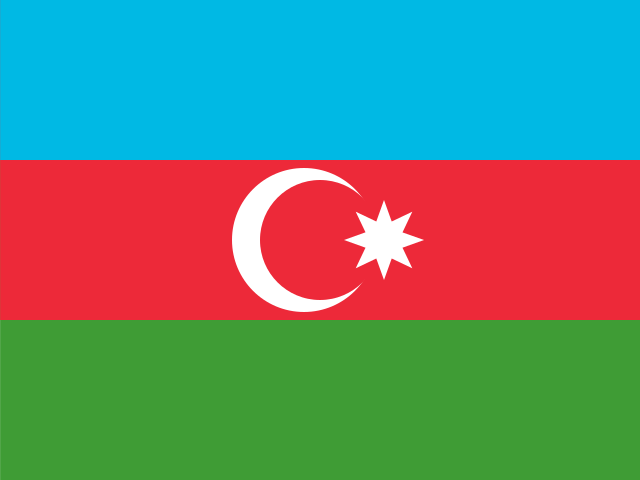
 Azerbaijan
Comprehensive education database information
Education System in Azerbaijan
Azerbaijan, officially known as the Republic of Azerbaijan, is situated in the southwestern region of Asia, bordered by the Caspian Sea to the east and sharing land boundaries with Iran, Armenia, Georgia, and Russia. With a population of approximately 8.2 million, Azerbaijan boasts a literacy rate of 98.8%. The official language is Azeri, spoken by the majority of the population, while other languages such as Lezgi, Russian, and Armenian are also present. The region has a rich historical background, with evidence of human habitation dating back to the Stone Age. Over the centuries, it has been influenced by various empires, including those of Alexander the Great and the Persians, and was part of the Russian Empire from 1813 until it gained independence following the collapse of the Soviet Union in 1991.
Overview of the Education System
Azerbaijan's education system reflects a unique blend of traditional influences coupled with remnants of the Soviet educational framework. Since gaining independence, the country has undergone significant reforms, leading to a more autonomous and adaptable educational structure. Education is compulsory and free for children between the ages of 6 and 15, allowing for a structured progression from primary education through to tertiary education.
Primary Education
- Compulsory Age: Education is mandatory for children from 6 to 15 years.
- Duration: Primary education lasts for 4 years, concluding when students reach 10 years of age.
- Characteristics: The primary education phase is basic by global standards and continues to grapple with the influences of both religious beliefs and the historical legacy of the Soviet system.
Middle Education
- After completing primary education, students proceed to 5 years of basic education.
- This stage continues until the students are 15 years old, marking the end of the compulsory education period.
- Students who successfully complete this level often move directly into the workforce, equipping them with essential skills for employment.
Secondary Education
Students in Azerbaijan have two distinct paths available for secondary education:
-
General Secondary School:
- Duration: An additional 2 years of study beyond middle education.
- Outcome: Graduates receive a Certificate of Complete Secondary Education.
-
Technical Secondary School:
- Focus: These institutions emphasize specialized training in various fields.
- Outcome: Graduates are awarded a Certificate of Complete Secondary Specialized Education.
Vocational Education
- The Ministry of Education oversees a network of vocational schools and lyceums.
- These institutions offer practical training in various sectors, particularly focusing on:
- Engineering
- Science, especially in geological and petrochemical disciplines.
Tertiary Education
Azerbaijan's tertiary education encompasses various types of institutions:
-
Types of Institutions:
- Universities
- Academies
- Institutes
- Colleges
- Conservatories
-
Autonomy: These institutions operate with a degree of autonomy but must comply with established educational standards set forth by the Ministry of Education.
-
Notable Institution:
- Baku State University: Founded in 1919, this is the oldest university in Azerbaijan, featuring 16 faculties and a notable alumni network of national leaders. Despite its historical importance, it currently holds a global ranking of 1,961.
Education Reform Initiatives
Azerbaijan has made significant strides in reforming its education system, particularly following its independence. Key initiatives include:
- Integration into the Bologna Process: Azerbaijan joined the Bologna process in 2005, aiming to align its higher education with European standards.
- New Law on Education: The 2009 Law on Education, which took 15 years to develop, established a new framework for doctoral education, transitioning to the degrees of Doctor of Philosophy and Doctor of Science.
- Educational Reform Programs: In 2009, the Azerbaijani government announced comprehensive plans for reforming both secondary and higher education, which included consolidating undergraduate specialties and restructuring master's degree programs.
In summary, Azerbaijan's education system is a dynamic framework that continues to evolve, balancing modern educational practices with its rich historical and cultural heritage. The emphasis on compulsory education and vocational training aims to prepare students for both higher education and the workforce, contributing to the nation’s ongoing development.