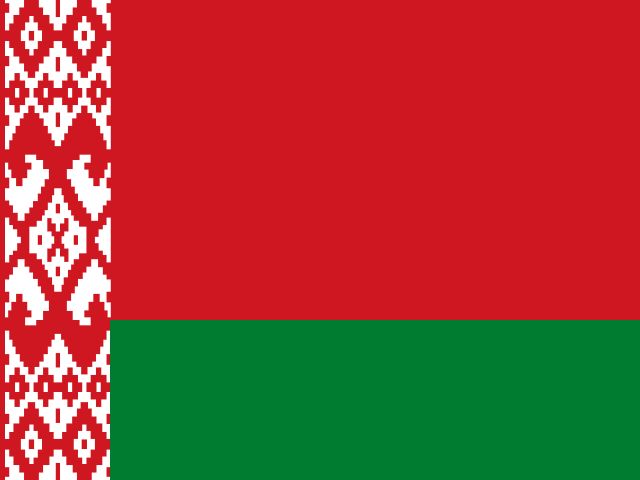
 Belarus
Comprehensive education database information
Education System in Belarus
Overview of Belarus
The Republic of Belarus, located in Eastern Europe, is a landlocked country bordered by Latvia, Lithuania, Poland, Russia, and Ukraine. With a population of approximately 9.7 million, it boasts an impressive literacy rate of 99.6%. The official languages of the country are Belarusian and Russian. Historically, the region has been influenced by various powers, including Poland, Prussia, and Russia. Following a series of political developments, Belarus established itself as a sovereign entity in the early 20th century, becoming a founding member of the USSR in 1922. The education system in Belarus reflects the Russian educational model, with its current framework established by a decree in 1994. The Ministry of Education is responsible for overseeing the educational landscape in the country.
Introduction to the Education System
Belarus offers a structured education system that is both compulsory and free from ages 6 to 15. This system is segmented into several key stages: Primary Education, Secondary Education, Vocational Education, and Tertiary Education. The educational framework is designed to provide students with a solid foundation, enabling them to pursue various academic and vocational pathways.
Primary Education
Key Details
- Age Range: 6 to 10 years
- Duration: 4 years
Focus Areas
The primary education stage emphasizes:
- Literacy: Basic reading and writing skills
- Numeracy: Fundamental mathematical concepts
- Essential Skills: Development of skills necessary for subsequent educational endeavors
Secondary Education
Secondary education is divided into two significant phases: Basic Secondary Education and Senior Secondary Education.
Basic Secondary Education
- Age Range: 10 to 15 years
- Duration: 5 years
- Outcome: Certificate of Basic Education upon completion at age 15
Curriculum
The curriculum for Basic Secondary Education is academically oriented and standardized across state schools, ensuring uniformity in educational quality.
Senior Secondary Education
After finishing Basic Secondary Education, students can choose from various educational tracks:
-
Academic Stream:
- Duration: 3 years
- Offered at gymnasiums, focusing on academic subjects.
-
Vocational Classes:
- Duration: 2 years
- Available at lyceums, geared towards practical skills and vocational training.
-
Practical Training:
- Provided at colleges, allowing students to obtain specific trades.
Vocational Education
Vocational education in Belarus is characterized by:
- Institutions: A variety of vocational training centers are available across the country.
- Focus:
- Providing refresher courses and opportunities for reskilling.
- Promoting ongoing education as a national priority.
- Fees: While vocational courses are available, they may come with associated costs, and there is limited central regulation over these institutions.
Tertiary Education
Tertiary education in Belarus comprises a range of institutions, including:
- Total Institutions: 44 state-controlled institutions
- 31 universities
- 6 academies
- 2 institutes
- 4 higher colleges
Enrollment
Approximately 300,000 students are enrolled in these institutions, contributing to a vibrant academic community.
Notable Institution
- Belarusian State University:
- Established in 1921, it is one of the leading educational institutions in the country.
- It offers a diverse array of programs across 17 faculties and is home to around 5,000 students, as well as several educational and research institutes.
Conclusion
The education system in Belarus is meticulously structured to ensure that students receive a well-rounded education, preparing them for various career paths and further studies. From primary education to tertiary levels, the system emphasizes both academic and vocational training, ultimately aiming to equip individuals with the skills necessary for success in a rapidly changing world.