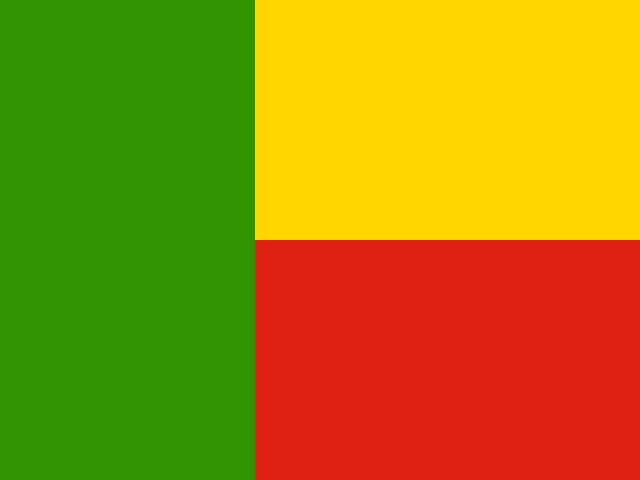
 Benin
Benin
Comprehensive education database information
Education System in Benin
Overview of Benin
The Republic of Benin is situated in West Africa, bordered by Togo to the west, Burkina Faso to the north, Niger to the northeast, Nigeria to the east, and the Bight of Benin to the south. With a population of approximately 8.5 million, Benin has a literacy rate of around 34.7%. The official language is French, although local languages such as Fon and Yoruba, among others, are widely spoken throughout the country. Benin's history is rich, tracing back to the powerful Kingdom of Dahomey in the 15th century, which was a significant regional force. Following colonial rule by France, Dahomey gained independence on August 1, 1960, and was renamed Benin in 1975.
Introduction to the Education System
The education system in Benin is designed to provide a structured approach to learning, encompassing various stages from primary through tertiary education. Although education is free and compulsory for children aged 6 to 11, actual school attendance is not strictly enforced. The system emphasizes foundational skills as well as vocational training, reflecting the country’s commitment to addressing both academic and practical educational needs.
Primary Education
Key Features
- Compulsory Age: Education is mandatory for children between the ages of 6 and 11.
- No Tuition Fees: Primary education is provided at no cost to families.
- Curriculum Structure: The educational framework follows a 6-4-3 model, with the first six years dedicated entirely to primary education, focusing on foundational skills.
Educational Goals
The primary level aims to equip students with essential literacy and numeracy skills, preparing them for further academic pursuits or vocational training.
Secondary Education
Lower Secondary
- Duration: Students engage in 4 years of lower secondary education.
- Curriculum Focus: The curriculum continues to build on the general academic foundation established in primary school.
- Examinations: At the conclusion of lower secondary education, students take the Brevet d'Études du Premier Cycle (BEPC), which is comparable to O-levels in other educational systems.
Upper Secondary
- Senior High School: Students wishing to continue their education proceed to senior high school for an additional 3 years.
- Baccalauréat Examination: To graduate, students must successfully pass the Baccalauréat examination, a prerequisite for university admission.
- Vocational Training Options: Students also have the option to attend vocational schools that provide specialized training across various fields.
Vocational Education
System Reforms
Benin has undertaken significant reforms in its vocational training system to better align educational outcomes with the labor market's needs.
Dual Apprenticeship Model
A key feature of the vocational education system is the dual apprenticeship model, which allows students to alternate between classroom instruction and practical on-the-job training. This approach aims to enhance the employability of graduates by providing them with hands-on experience.
Tertiary Education
Institutions and Accessibility
Benin's tertiary education landscape includes several institutions, primarily concentrated in urban areas, which may limit access for students from poorer regions. Notable lower order institutions include:
- School of Applied Economics & Management
- National School of Administration & Prosecutor Training
- Polytechnic Institutes
- Teachers’ Training Schools
- Various other specialized institutions
Universities
There are two major universities in Benin:
- National University of Benin: Established in 1970 as the Université du Dahomey, this is the more prestigious institution, comprising 19 faculties and 6 campuses. It plays a vital role in higher education and research within the country.
Conclusion
Benin's education system is characterized by its commitment to providing accessible education and vocational training to its youth. While challenges remain, particularly regarding enforcement of compulsory education and accessibility to higher education, ongoing reforms aim to enhance the quality and relevance of the educational experience for all students. The focus on foundational skills and practical training is essential for preparing the next generation of Beninese citizens to meet the demands of a changing economy.