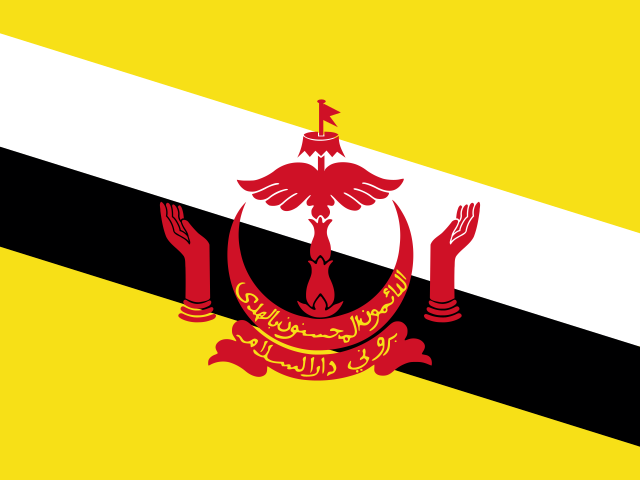
 Brunei
Comprehensive education database information
Education System in Brunei
Overview of Brunei
Brunei Darussalam, commonly known as Brunei, is a small sovereign state located on the northern coast of the island of Borneo, bordered by Malaysia and Indonesia. With a population of approximately 381,371, Brunei boasts a literacy rate of 92.7%. The official language is Malay, although English and Chinese are also widely spoken. Established in the 14th century, Brunei has a rich history, having been a British protectorate since 1888 before gaining independence on January 1, 1984. The discovery of oil in 1929 significantly contributed to Brunei's wealth, making it one of the countries with the highest gross domestic products globally. The education system in Brunei is managed by the Ministry of Education, which emphasizes accessibility and quality across all levels.
Education System Overview
Brunei's education system is characterized by its free access to education from primary through tertiary levels, including opportunities for studying abroad. While education is not compulsory, the government provides substantial resources for its citizens, such as hostels, meals, textbooks, and transportation. The system is designed to foster a well-rounded education, preparing students for both academic and vocational paths.
Primary Education
Structure and Duration
- Length: Primary education lasts for 6 years, commencing after 1 year of pre-primary education.
Assessment
- National Tests: Students must complete national assessments at two critical points:
- At the midpoint of their primary education.
- Upon completion of primary education, at the end of the 6th year.
Middle Education
Duration and Curriculum
- Length: Middle education encompasses 3 years of schooling.
Examinations
- Brunei Junior Certificate of Education (BJCE): Students take this examination at the end of their middle education, with results significantly impacting their future educational trajectories.
Secondary Education
Eligibility and Duration
- Entry Requirements: Students who perform satisfactorily in the BJCE are eligible to advance to secondary education.
- Length: Secondary education spans 2 to 3 years, focusing on preparing students for further studies.
Academic Pathways
- O-Levels: During secondary education, students work towards obtaining sufficient Ordinary Level (O-Level) qualifications.
- A-Levels: Those who excel may continue their education with an additional 2 years of study, culminating in Advanced Level (A-Level) qualifications.
Vocational Education
Alternative Pathways
- Options After Middle School: Students have the choice to pursue vocational education rather than traditional secondary schooling.
Types of Institutions
- Technical Colleges: These focus on developing technical skills.
- Craft Colleges: Institutions that emphasize practical craft skills.
Programs Offered
Vocational education includes programs in fields such as:
- Nursing
- Agriculture
- Primary school teaching
Tertiary Education
Institutions and Opportunities
Brunei features a range of tertiary education institutions, including:
- Institutes
- Technical colleges
- Training centers
- Colleges
Overseas Education
When local educational facilities cannot meet specific needs, the government supports students in pursuing education abroad.
University of Brunei Darussalam
Founded in 1985, the University of Brunei Darussalam serves as the country's primary higher education institution. Its missions encompass:
- Education
- Research
- Community Service
Academic Faculties
The university offers diverse programs across several faculties, including:
- Arts & Social Sciences
- Business Economics & Policy Studies
- Science
- Language
- Health Sciences
- Education
- Brunei Studies
Conclusion
Brunei's education system is a well-structured framework that aims to provide accessible and quality education for all citizens. With an emphasis on both academic and vocational training, the system is designed to equip students with the necessary skills and knowledge to thrive in an increasingly competitive world.