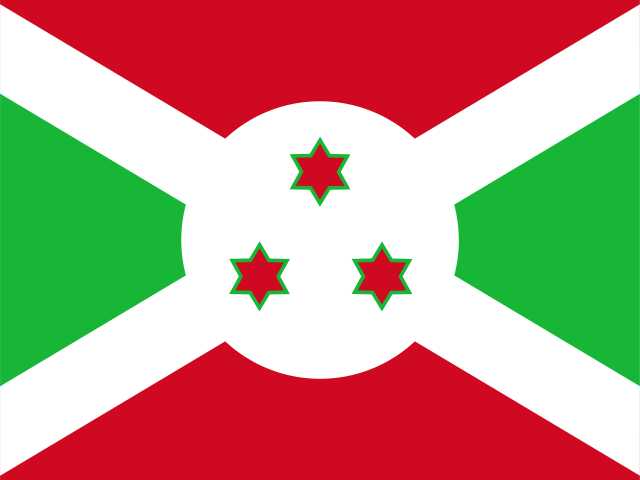
 Burundi
Comprehensive education database information
Education System in Burundi
Overview of Burundi
Burundi, officially known as the Republika y'u Burundi, is a landlocked nation situated in the southwestern region of Africa. It shares borders with Rwanda, Tanzania, the Democratic Republic of the Congo, and Lake Tanganyika. The country has a population of approximately 8.7 million people, with a literacy rate of 59.3%. The official languages are Kirundi and French, while Swahili is predominantly spoken in areas near Lake Tanganyika and the city of Bujumbura.
Historically, the region has been inhabited since ancient times, beginning with the Twa pygmy tribes around 70,000 BC. The Hutu people migrated to the area roughly 5,000 years ago, followed by the Tutsi in the late 15th century. Burundi became a German colony in 1899 and transitioned to Belgian administration after World War I. The country gained independence on July 1, 1962, but has since experienced conflicts primarily between the Hutu and Tutsi groups, leading to significant loss of life and social strife.
Education System Overview
The education system in Burundi is structured to provide free and compulsory education for children aged 6 to 12. However, enforcement of attendance is weak, and many students do not complete their education. The system has undergone reforms to streamline the length of education, which now spans 12 years, divided into primary, lower secondary, and upper secondary education.
Primary Education
- Compulsory Duration: Primary education is mandatory for 6 years, although challenges persist regarding enrollment.
- Enrollment Issues: An estimated 500,000 children are not enrolled in school, presenting a significant barrier to education access.
- Completion Rates: Among those who do start school, only about 36% manage to complete primary education successfully.
- Gender Balance: Enrollment and completion rates are relatively equitable for both genders.
Secondary Education
- Duration: Secondary education is designed to last for an additional 6 years, divided into lower and upper secondary education.
- Access Challenges: Very few students transition to secondary school, with the average duration of schooling being just under 5 years.
- Language of Instruction: The primary mediums of instruction in secondary schools are Kirundi and French.
- Educational Model: The secondary education structure is influenced by the French educational system.
Tertiary Education
- Enrollment Rate: Participation in tertiary education remains quite low, with an enrollment rate of just over 1% of eligible students.
- Primary Institution: The main institution for higher education is the University of Burundi, located in Bujumbura. Established in 1960, it has faced challenges, particularly due to infrastructure damage during the civil conflict.
- Current Capacity: The university currently enrolls around 3,000 students in conditions that are less than ideal.
- Faculties Offered: Various faculties at the university include:
- Arts and Humanities
- Law
- Medicine
- Psychology and Educational Sciences
- Pure Sciences
- Applied Sciences
- Agricultural Sciences
- Specialized Institutes: The university also accommodates several institutes focusing on:
- Agriculture
- Commerce
- Sports and Physical Education
- Technology
- Pedagogy
Teacher Education
Educators in Burundi receive training through specific institutions, which vary based on the level of education they will teach:
- Primary School Teachers: Training occurs at pedagogical lycées, which offer a 4-year program following the completion of the Certificat du Tronc Commun.
- Lower Secondary Teachers: These educators are trained at the Institut de Pédagogie Appliquée, completing a 3-year program that results in the Diplôme Professionnel d’Enseignement.
- Upper Secondary Teachers: Training for these teachers lasts 4 years, leading to the Diplôme de Licencié Agrégé de l’Enseignement Secondaire. Admission to these programs requires a Diplôme d'État.
Conclusion
The education system in Burundi faces numerous challenges, including low enrollment and completion rates, underfunded institutions, and limited access to higher education. Despite these obstacles, efforts are being made to improve educational access and quality, aiming to foster a more educated population capable of contributing to the country's development.