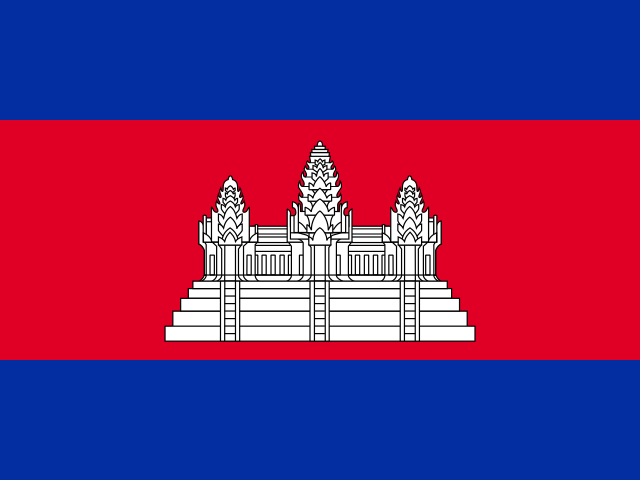
 Cambodia
Comprehensive education database information
Education System in Cambodia
Cambodia, a Southeast Asian nation, has a rich historical background marked by periods of colonization and conflict. The country became a French protectorate in 1863 and was later occupied by Japan during World War II. It gained independence from France on November 9, 1953, transitioning into a constitutional monarchy under King Norodom Sihanouk. The Khmer Rouge regime in the late 1970s severely disrupted the nation, leading to the near-total collapse of the education sector. Today, Cambodia is governed by King Norodom Sihamoni, the son of the former king, and is in a process of rebuilding its education system, which is overseen by the Ministry of Education, Youth, and Sports. However, the system faces significant challenges, such as a shortage of teachers and inadequate school facilities.
Overview of the Cambodian Education System
The education system in Cambodia is undergoing reform to address its historical challenges. While education is theoretically free, various enrollment fees can create disparities, particularly affecting children from low-income families. The system aims to provide equitable access to education, yet many obstacles remain.
Primary Education
- Duration: Primary education lasts for 6 years, beginning at age 6.
- Challenges: Although primary education is intended to be free, many families encounter financial barriers that prevent their children from enrolling. This is particularly pronounced among the economically disadvantaged.
Secondary Education
- Duration: Secondary education is divided into two segments totaling 6 years: lower secondary (3 years) and upper secondary (3 years).
- Model: The structure of secondary education primarily follows the Vietnamese educational model.
- Tensions: There exists a significant tension between Buddhist schools and state schools, both of which are in recovery from the impacts of the Khmer Rouge regime.
- Teacher Conditions:
- Teachers in Cambodia often face low salaries, which leads many to charge unofficial fees or seek additional employment. This situation can result in neglect of classroom responsibilities.
- Historical Context: The education system is still striving to regain the quality and standards that were in place prior to the Khmer Rouge's rule.
Vocational Education
Vocational education initiatives are crucial for addressing the historical lack of opportunities for the impoverished population of Cambodia. The government is implementing programs designed to reduce educational disparities and provide pathways for self-improvement for future generations.
Tertiary Education
Cambodia's higher education landscape includes a variety of institutions, notably:
- Royal University of Phnom Penh
- Royal Agricultural University
- Royal University of Fine Arts
- Various faculties specializing in Medicine, Law, Economics, and Business.
The Institute of Technology of Cambodia, previously known as the Higher Technical Institute of Soviet-Khmer Friendship, represents a significant institution for technical education. Additionally, the Maharishi Vedic University, supported by Australian funding, operates in the rural Prey Veng Province.
Royal University of Phnom Penh
- Established in 1960 with French support, the Royal University of Phnom Penh is the oldest university in Cambodia.
- After reopening in 1998, it currently serves around 4,000 students.
- The university offers a diverse range of academic programs, including:
- Khmer Literature
- Biology
- Chemistry
- Computer Science
- Geography
- Mathematics
- Philosophy
- Psychology
- Sociology
The Cambodian education system continues to evolve, focusing on the provision of equitable access to quality education for all citizens. Despite the challenges, the ongoing reforms and efforts indicate a commitment to improving educational outcomes for future generations.