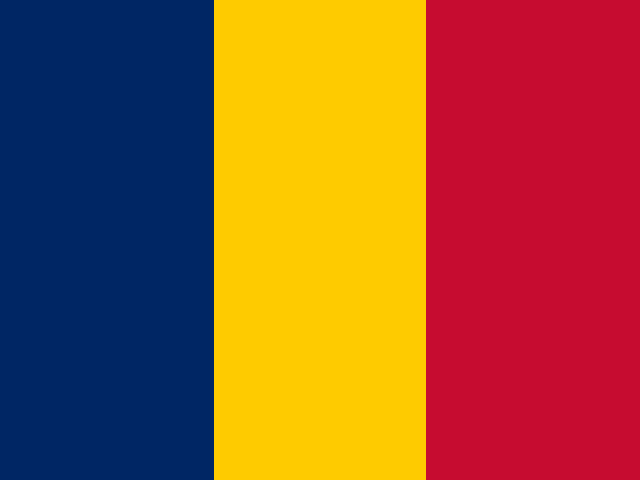
 Chad
Chad
Comprehensive education database information
Education System in Chad
Country Overview
The Republic of Chad, located in Central Africa, is a landlocked nation bordered by Libya, Sudan, the Central African Republic, Cameroon, Nigeria, and Niger. With a population of approximately 10.1 million, Chad is characterized by a diverse linguistic landscape, featuring French and Arabic as its official languages, alongside over 120 local languages and dialects. Unfortunately, the country faces significant economic challenges, making it one of the poorest in Africa. The roots of civilization in Chad can be traced back to the 7th century BC, and since gaining independence from France on August 11, 1960, it has remained a crucial crossroads for various African cultures.
Introduction to the Education System
Chad's education system is structured to provide a framework for learning that spans several levels, including primary, secondary, vocational, and tertiary education. Despite the challenges posed by economic constraints and low literacy rates—estimated at 25.7%—efforts are underway to improve educational access and quality. The system is designed to accommodate various educational pathways, ensuring that students can pursue academic or vocational training based on their capabilities and interests.
Education Levels
Primary Education
- Age of Enrollment: Children typically start their primary education at age 6 in urban areas and at age 7 in rural regions.
- Duration: The primary education cycle lasts for 6 years.
- Financial Implications: While primary education is officially free, families often bear additional costs, including:
- School supplies and fees
- Teacher salaries
- Examinations: At the end of primary school, students must pass the Certificat d'Études Primaires (CEP) examination, which determines their eligibility for secondary education or vocational training.
Secondary Education
- Gender Disparity: Enrollment in secondary education shows a stark gender imbalance, with more boys attending than girls.
- Duration: Secondary education is divided into two segments, each lasting 3 years, totaling 6 years.
- Funding: The government provides financial support for the first 3 years; however, this assistance is withdrawn for the latter half of the secondary education cycle.
- Socioeconomic Influences: Students who complete their secondary education and obtain a leaving certificate typically come from wealthier urban families, reflecting socioeconomic disparities in educational attainment.
Vocational Education
- Alternative Pathways: For students who do not progress to secondary school, vocational education offers an opportunity to study various manual and technical disciplines at specialized institutions.
- Certification: Successful completion of vocational training over a period of 6 years results in the award of a Certificat d'Aptitude Professionnelle (CAP).
Tertiary Education
- Leading Institution: The University of N'Djamena, established in 1971, serves as the primary institution for higher education in Chad.
- Available Faculties:
- Exact and Applied Sciences
- Business and Economics
- Literature and Humanities
- Health Sciences
- Degree Programs: The university offers a range of academic qualifications, including bachelor's, master's, and doctorate degrees.
- Recognition: Degrees from the University of N'Djamena are acknowledged by international bodies such as:
- UNESCO’s International Association of Universities
- African Association of Universities
- Association Universitaire de la Francophonie
Conclusion
Chad's education system, while facing significant challenges, serves as a vital component in the nation's development. With ongoing efforts to enhance educational access and quality, there is hope for a brighter future where all children can benefit from a comprehensive and inclusive education, paving the way for personal and national growth.