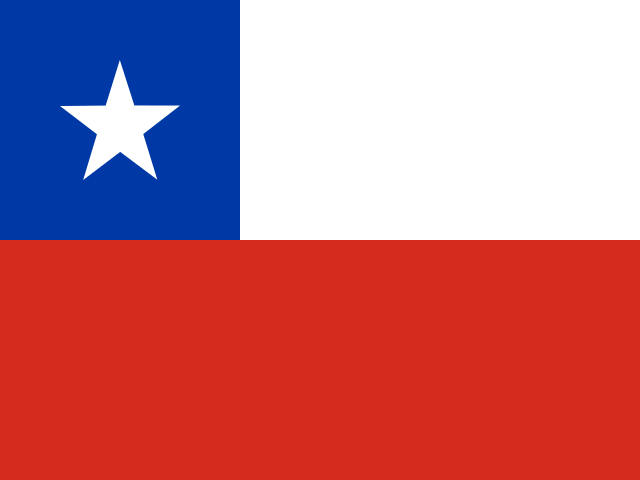
 Chile
Chile
Comprehensive education database information
Education System in Chile
Overview of Chile
Chile, located on the western edge of South America, is known for its diverse geography, rich history, and vibrant culture. The education system in Chile has evolved significantly over the centuries, reflecting the country's social, political, and economic changes. Education has been an integral part of Chilean society since colonial times, when early schools were established by local councils and the Catholic Church. Over the years, the system has transitioned from limited access to becoming one of the most structured educational frameworks in Latin America.
Introduction to the Education System
The Chilean education system is characterized by its four primary levels: pre-school, primary, secondary, and tertiary education. While attendance is voluntary at the pre-school level, both primary and secondary education are mandatory, with the government covering a substantial portion of the costs. This structure is designed to promote educational access and equity, allowing students from various socio-economic backgrounds to benefit from formal education.
Education Levels
Pre-School Education
- Voluntary Participation: Pre-school education is not mandatory, but it is encouraged as a foundation for early learning.
- Age Group: Typically caters to children aged 3 to 5 years old, focusing on social, emotional, and cognitive development through play-based activities.
Primary Education
- Compulsory Duration: Primary education, known as Enseñanza Básica, is mandatory for all children and lasts for 8 years.
- Curriculum Focus: The curriculum includes fundamental subjects such as language, mathematics, science, and social studies, aiming to provide a well-rounded education.
Secondary Education
Upon completing primary education, students transition to secondary school (Enseñanza Media), which lasts until they are approximately 18 years old.
- Structure:
- Grades 9 and 10: These grades follow a standardized curriculum across the nation.
- Grades 11 and 12: Students have the option to specialize in one of two tracks:
- Sciences: Emphasizing subjects like mathematics, physics, biology, and chemistry.
- Humanities: Focusing on literature, philosophy, history, and social sciences.
In economically disadvantaged regions, students may also receive vocational training in practical subjects such as:
- Electricity
- Mechanics
- Metal assembly
This vocational education aims to enhance skills, improve employability, and provide students with opportunities to fund their further education.
Vocational Education
Students may opt for a technical secondary school after completing the first two years of secondary education. This pathway provides training in areas such as:
- Industrial Training
- Commercial Training
- Technical Training
- Mixed Training
Graduates of these programs acquire practical skills that prepare them for the workforce.
Tertiary Education
Chile is home to a robust tertiary education sector, featuring 25 state universities and over 50 private universities. However, there are concerns regarding the declining quality of some newer private institutions. The admissions process across universities is standardized and overseen by the Council of Rectors (Consejo de Rectores), which includes:
- Entrance examinations in mathematics and language
- Additional subject-specific assessments
A student's overall ranking for university admission combines their academic performance and examination results.
The Universidad de Chile, founded in 1622, stands as the oldest university in the country. It has undergone several name changes throughout its history, reflecting its evolution and significance in Chilean education.
Conclusion
The education system in Chile has a rich history and a well-defined structure that facilitates access to education for all students. With a focus on both academic and vocational training, Chile aims to equip its youth with the skills and knowledge necessary to thrive in an ever-evolving global landscape. Through continued reforms and investments, Chile seeks to enhance the quality and inclusivity of its education system, ensuring that future generations can benefit from the opportunities that education provides.