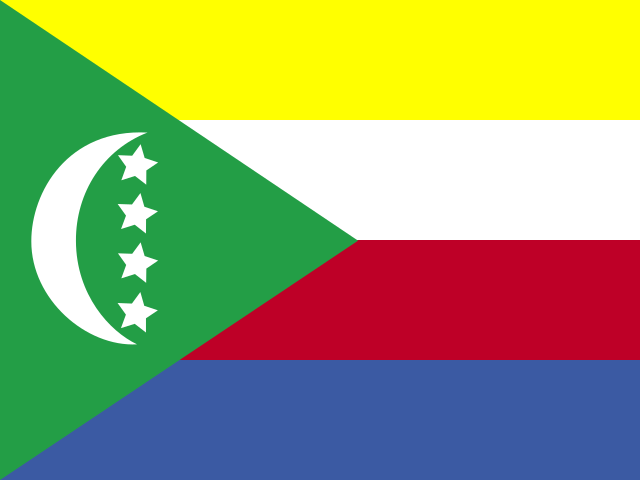
 Comoros
Comprehensive education database information
Education System in Comoros
The Union of Comoros is an archipelago located in the Indian Ocean, positioned off the eastern coast of Africa, specifically at the northern end of the Mozambique Channel between Madagascar and Mozambique. Comprising several islands, it is noted for being the southernmost member of the Arab League. With a population of approximately 731,775, Comoros stands out as one of the least populated yet densest countries worldwide. The literacy rate is around 56.5%, highlighting significant challenges in educational access and quality. The official languages are Arabic and French, while Shikomoro, a dialect that combines elements of Swahili and Arabic, is commonly spoken among the population. Human settlements on the islands date back to the 6th century AD, with Swahili traders arriving by the 9th century. The islands were colonized by France in the early 19th century and gained independence on September 5, 1975.
Overview of the Education System
Education in Comoros is characterized by its free and compulsory nature for children aged 6 to 14, although the enforcement of attendance remains a challenge. The educational framework operates primarily in French and Arabic, reflecting the linguistic diversity of the nation. The Ministry of National Education, Teaching, and Research oversees the educational policies and practices across the islands.
Levels of Education
Primary Education
In Comoros, the primary education system consists of two parallel pathways: l'École Quranic (Koranic Schools) and l'École Officielle (Official Schools).
-
Koranic School: Almost all children attend a Quranic school for 2 to 3 years prior to entering formal primary education. These institutions focus on religious teachings and foundational literacy.
-
Official School: Following their time in Quranic schools, children begin l'Enseignement élémentaire (Primary School) at age 6, which lasts for 6 years. This structure was previously set at 7 years before reforms in 1995. Upon completion, students receive the Diplôme de Fin D'Études Élémentaires (DFEE), certifying their basic education.
Secondary Education
Secondary education in Comoros is divided into two main cycles:
-
Lower Secondary Education (l'enseignement secondaire première cycle): Admission to this 4-year program is contingent upon passing a national examination. Upon completion, students earn the Brevet de Premier Cycle (BEPC).
-
Upper Secondary Education (l'enseignement secondaire deuxième cycle): This stage lasts for an additional 3 years. At the conclusion of this cycle, students take an external examination leading to the Baccalauréat de l'Enseignement du Second Degré, which is essential for higher education pursuits.
Post-Secondary Education
Post-secondary education opportunities in Comoros are primarily offered through the **École Nationale de l'Enseignement Supérieur de MVouni** (National School of Higher Education of MVouni). This institution provides programs lasting 2 to 3 years in various fields, including:
- Teacher training
- Agricultural education
- Health sciences
- Business studies
Although Comoros is eligible to engage with initiatives such as the Virtual University for Small States of the Commonwealth (VUSSC), it is not currently listed as a participant country.
Conclusion
The education system in Comoros reflects a blend of traditional and formal learning pathways, addressing both religious and secular educational needs. While initiatives have been made to enhance literacy and educational access, challenges such as enforcement of compulsory education and resource allocation remain prevalent. Continued efforts are necessary to improve the overall educational landscape and increase literacy rates within this unique island nation.