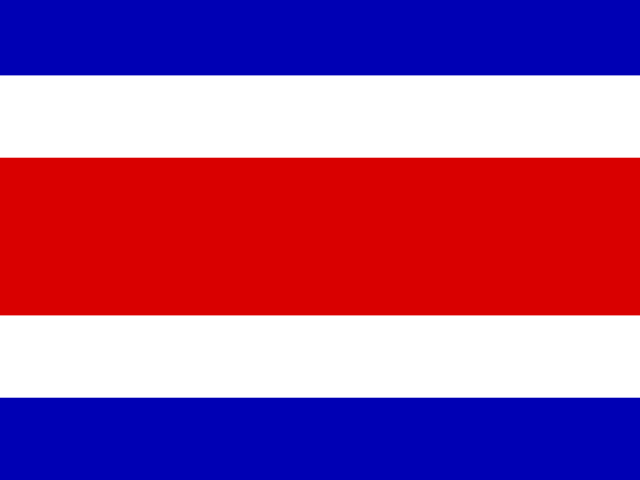
 Costa Rica
Comprehensive education database information
Education System in Costa Rica
Costa Rica, situated in Central America, is known for its stable economy and a history marked by relative peace. Bordered by Nicaragua to the north and Panama to the south, the country features a diverse landscape that includes both Caribbean and Pacific coastlines, as well as mountainous regions shaped by volcanic activity. With a population of approximately 3.95 million, Costa Rica has built its economy around tourism, agriculture, and electronic exports.
The country's education system is overseen by the Ministerio de Educación Pública, which has made significant strides in increasing literacy and educational access. Historically, education in Costa Rica began with a limited number of schools operated by the Catholic Church. The establishment of the Universidad de Costa Rica in 1814 marked the beginning of formal higher education in the country. Following independence in 1821, Costa Rica expanded its educational programs, and by the mid-19th century, primary education became both compulsory and free. Noteworthy reforms in 1964 diversified the educational tracks available, creating pathways for both academic and vocational studies.
Overview of the Education System
Costa Rica's education system is well-structured, with a strong emphasis on promoting literacy and educational attainment. The system is divided into several key levels: primary, secondary, vocational, and tertiary education.
Primary Education
- Duration: Primary education lasts 6 years.
- Accessibility: Schools are established in every rural area, ensuring that education is accessible to all communities.
- Cost: Education at this level is free, with only nominal fees required for some services.
Secondary Education
- Structure: The first year of secondary education focuses on academic subjects.
- Streams: Following the first year, students can choose between two specialized tracks for the subsequent 4 years:
- Professional Track: Geared towards academic subjects and preparation for higher education.
- Technical Track: Focused on practical skills and vocational training.
- Core Curriculum: Students are required to study essential subjects throughout their secondary education, including:
- Foreign Language
- Mathematics
- Science
- Social Science
Vocational Education
Costa Rica offers a dual approach to vocational training:
- Urban Centers: Formal education programs are provided through training centers that focus on in-demand trades and technical professions.
- Rural Areas: Residents in these regions often utilize public libraries to engage in self-directed learning and skill development.
Tertiary Education
Since 1940, Costa Rica has established four public universities, which play a significant role in the nation's higher education landscape:
- Costa Rican Institute of Technology
- Distance State University
- National University
- University of Costa Rica (the oldest and largest institution)
- Enrollment: The University of Costa Rica serves over 30,000 students, with many benefiting from scholarship programs.
- Tuition Fees: The cost of education is highly subsidized, with students typically paying no more than $200 per semester.
- Campus Locations: The main campus is in San Pedro, with additional campuses in:
- Alajuela
- Cartago
- Puntarenas
- Turrialba
Conclusion
The education system in Costa Rica is a testament to the nation's commitment to promoting literacy and providing accessible education. With a strong framework that offers diverse pathways for students, from primary through tertiary levels, Costa Rica continues to invest in its human capital, fostering a well-educated populace ready to contribute to the country's ongoing development.