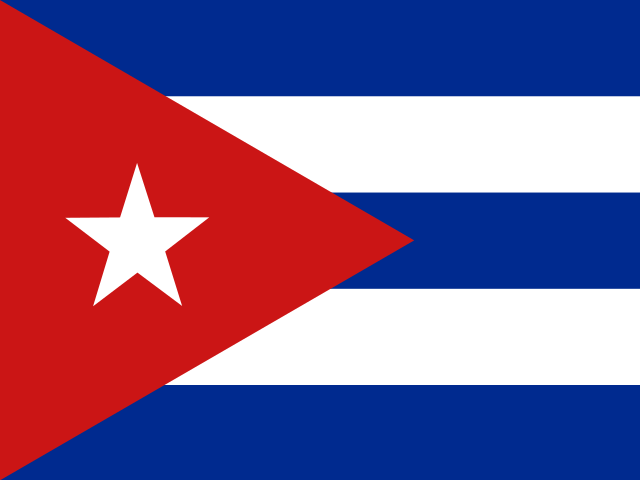
 Cuba
Cuba
Comprehensive education database information
Education System in Cuba
Cuba, officially known as the Republic of Cuba, is an island nation located at the crossroads of the Atlantic Ocean, the Gulf of Mexico, and the Caribbean Sea. It is situated just 150 kilometers from the United States, across the Straits of Florida. The country comprises an archipelago of over 1,600 islands, islets, and cays, featuring diverse landscapes that range from flat plains to mountainous regions, with the Sierra Maestra being the most prominent range. The population of Cuba is approximately 11.5 million, with a remarkable literacy rate of 99.8%. Spanish serves as the official language.
Historically, Cuba has undergone significant transformations, particularly in its education system. The roots of formal education in Cuba can be traced back to colonial times, but it was not until the late 20th century that substantial reforms were implemented to create an inclusive and universal education system.
Overview of the Education System
The Cuban education system has experienced considerable changes since its nationalization in 1959, when educational access was limited for many children. Today, Cuba is recognized for having one of the highest literacy rates globally. The education framework in Cuba emphasizes not only academic achievement but also loyalty to the state and a commitment to community service.
Primary Education
- Duration: 6 years
- Focus: Primary education serves as the foundation for learning and emphasizes the essential "3 R's":
- Reading
- Writing
- Arithmetic
Middle Education
- Duration: 3 years
- Objective: Middle education aims to provide students with a solid grounding in various subjects, including:
- Languages
- Technology
- Social Sciences
- Pathways: Upon completion of middle education, students have two options:
- Continue to secondary school
- Transition to vocational training programs for practical career preparation
Secondary Education
- Duration: 3 years
- Characteristics:
- Secondary education builds upon the foundation laid in middle school and enforces higher academic standards.
- Participation in school para-military parades is mandatory.
- School breaks are often dedicated to social service, which embodies the Cuban principle of contributing to the community.
- Certification: Students who successfully complete secondary education receive a bachillerato certificate.
Vocational Education
- Pathways: Students who choose vocational training after middle school can pursue two main streams:
- Skilled worker programs
- Courses for middle-level technicians
- Further Opportunities: Graduates from technician programs who achieve satisfactory grades may advance to technological institutes for further training.
Tertiary Education
- Historical Context: Cuba has a long-standing tradition of academic excellence, with the establishment of the University of Havana in 1727 marking a significant milestone in higher education.
- Current Institutions: The higher education landscape in Cuba includes:
- Universities
- Higher institutes
- Pedagogical institutes
- Centers for higher education
- Polytechnic institutes
- Management: The Ministry of Higher Education governs policies related to both undergraduate and graduate programs, overseeing:
- Course content
- Teaching methodologies
- Instructional practices
- Allocation of student placements
- Enrollment: Currently, more than 110,000 citizens are enrolled in higher education institutions, with an expectation that graduates will apply their skills in rural communities, often working for salaries below the national average.
In conclusion, Cuba's education system reflects the country's commitment to providing accessible and inclusive education to all citizens. While it has made remarkable strides in literacy and educational access, the system also instills a sense of civic duty and loyalty to the nation, shaping the values of its students in the process.