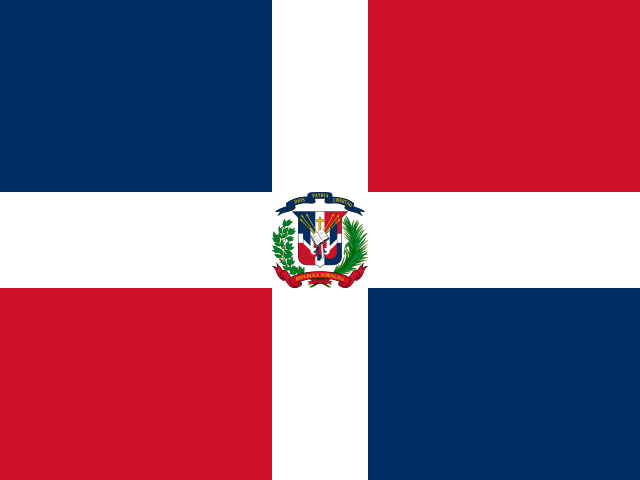
 Dominican Republic
Comprehensive education database information
Education System in Dominican Republic
The Dominican Republic, located on the eastern two-thirds of the island of Hispaniola in the Caribbean, is a nation with a rich historical background. The capital city is Santo Domingo, and the official language is Spanish. The island was first encountered by Christopher Columbus in 1492, leading to centuries of European colonization, including Spanish and French influences. The country gained independence from Spain in 1844. Over the years, the Dominican Republic has faced political turbulence, notably under long dictatorships in the 20th century, but has recently enjoyed democratic governance. The nation has experienced robust economic growth, largely driven by tourism and free trade initiatives. As of now, the literacy rate stands at approximately 85%, reflecting significant improvements over previous decades.
Overview of the Education System
The education system in the Dominican Republic is structured to provide several tiers of learning, including primary, secondary, vocational, and tertiary education. The government aims to ensure that education is both free and compulsory, though challenges remain, particularly for students from lower socioeconomic backgrounds.
Primary Education
-
Free and Compulsory: Education in the Dominican Republic is provided at no cost and is mandatory for children. This aligns with basic educational standards similar to those found in Western countries, whether the schooling is conducted in public or private institutions.
-
Literacy Rate: Approximately 85% of the population is literate, indicating a positive trend in educational attainment.
-
Structure:
- Pre-school: This stage lasts for 1 year, preparing children for formal education.
- Primary School: Following pre-school, primary education lasts for 6 years, focusing on foundational skills and knowledge.
Secondary Education
-
Continuation: A considerable percentage of students who complete primary education proceed to secondary school, which lasts for an additional 2 years.
-
Purpose: The goal of secondary education is to bridge the gap to higher education, emphasizing academic subjects and essential skills.
-
Challenges: Students from economically disadvantaged backgrounds often encounter obstacles due to inadequate preparatory education, impacting their success in secondary school.
Compulsory Secondary Education
-
Completion Rates: Many students from lower-income families struggle to complete the full 4 years of compulsory secondary education.
-
System Design: The education framework primarily encourages aspirations towards tertiary education among upper- and middle-class youth.
-
Certification: Upon successful completion of secondary education, students receive a bachillerato degree, which is equivalent to a high school diploma.
Vocational Education
-
National Technical Vocational Training Institute: Established in 1980, this institution aims to continuously improve vocational training.
-
Programs:
- The institute oversees vocational training programs in collaboration with various training centers.
- It plays a critical role in training trainers, enhancing the overall quality of vocational education.
Tertiary Education
-
Primary Institution: The University of Santo Domingo, founded in 1538, is recognized as the oldest university in the Americas and is the principal state-owned institution for higher education.
- Funding: Students enrolled here receive a free education, as the university is entirely funded by the government.
-
Private Alternatives: Notable private institutions, such as the Pontifical Catholic University Madre y Maestra, also contribute to the educational landscape.
-
Accessibility: Despite the presence of various higher education institutions, access to tertiary education remains a privilege largely reserved for those with sufficient financial means.
In conclusion, the education system in the Dominican Republic strives to provide equitable access to learning opportunities for all citizens. While significant strides have been made, particularly in increasing literacy rates and expanding access to primary and secondary education, ongoing efforts are necessary to address the disparities faced by students from lower socioeconomic backgrounds.