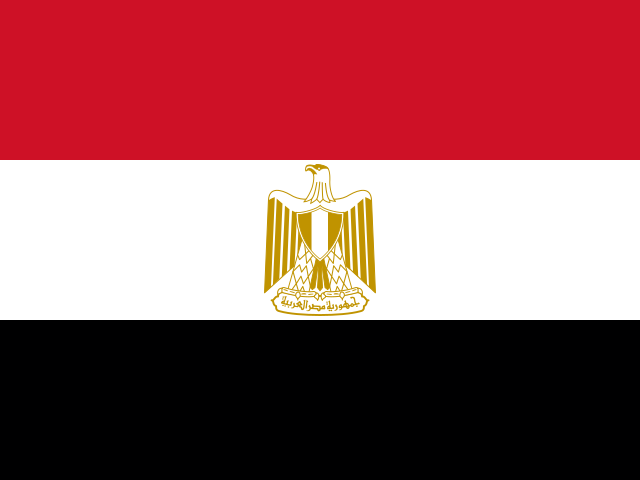
 Egypt
Egypt
Comprehensive education database information
Education System in Egypt
Egypt, officially known as the Arab Republic of Egypt, is situated at the northeastern Mediterranean coast of Africa. It shares borders with Libya to the west, Sudan to the south, the Red Sea to the east, and Israel and Gaza to the northeast. With a population of approximately 80 million, Egypt has a literacy rate of around 74%. The predominant religion is Sunni Islam, with significant communities of Coptic Christians. The official language is Arabic, but English and French are also widely spoken, especially among the educated population. The education system in Egypt has evolved over centuries, influenced by its rich cultural history and various periods of foreign rule.
Overview of the Education System
The education system in Egypt is comprehensive and encompasses various levels, offering diverse pathways for students. It is divided into several key stages: Primary Education, Middle Education, Secondary Education, Vocational Education, and Tertiary Education. The system is characterized by both secular and religious educational structures, with public, private, and Al-Azhar institutions coexisting.
Primary Education
- Compulsory Education: Education is compulsory starting at age 6, following kindergarten.
- Duration: Primary education lasts for 6 years, culminating in the Shehadet Al-Ibtidaiya certificate for state school graduates and the Shehadet Al-Ibtidaiya Al-Azharia for those in the Al-Azhar system.
- School Types: Students can choose from state-run, religious, or private schools, depending on their preferences and circumstances.
Middle Education
- Preparatory Schooling: Following primary education, students attend 3 years of preparatory school.
- Certification: At the conclusion of this stage, pupils are awarded a basic education completion certificate known as the Shehadet Al-Iadadaiya or the Shehadet Al-Iadadaiya Al-Azharia for Al-Azhar students.
- Aptitude Assessment: Students' skills and interests are assessed during this period to guide them toward suitable secondary education options.
Secondary Education
- Streams: Secondary education is divided into three primary streams:
- General Education: A 3-year program leading to the Thanaweya a'Amma certificate.
- Technical Education: This can last 3 to 5 years and focuses on specialized fields such as industrial, commercial, or agricultural studies, with corresponding certifications awarded.
- Vocational Education: Aimed at equipping students with practical skills for immediate employment.
- Pathways: Both general and technical secondary education provide pathways for students to pursue higher education opportunities.
Vocational Education
- Initial Training: Vocational education begins in specialized schools designed to equip students with practical skills.
- Further Opportunities: Post-training, students can either enter the workforce or continue their education in vocational centers.
- Government Focus: The government prioritizes vocational training to address skill shortages identified by businesses as a significant barrier to market entry.
Tertiary Education
- System Overview: Egypt has a robust tertiary education system, with approximately 30% of the population engaged in higher education.
- Institutions:
- Public Universities: 17
- Private Universities: 16
- Private Higher Education Institutions: 89
- Public Non-University Facilities: 51
- Academic Freedom: There exists an ongoing tension between the government’s oversight and the quest for academic freedom within institutions.
Historical Context
- Al-Azhar University: Founded in AD 970, Al-Azhar University is renowned for its role in Arabic literature and Sunni Islamic studies, making it one of the oldest universities globally. Its educational model has evolved uniquely, differing from the traditional European doctorate system.
The education system in Egypt reflects the nation’s historical and cultural narrative, providing various educational pathways that cater to the diverse needs of its population. Despite challenges, the commitment to education continues to be a priority for the country's development and progress.