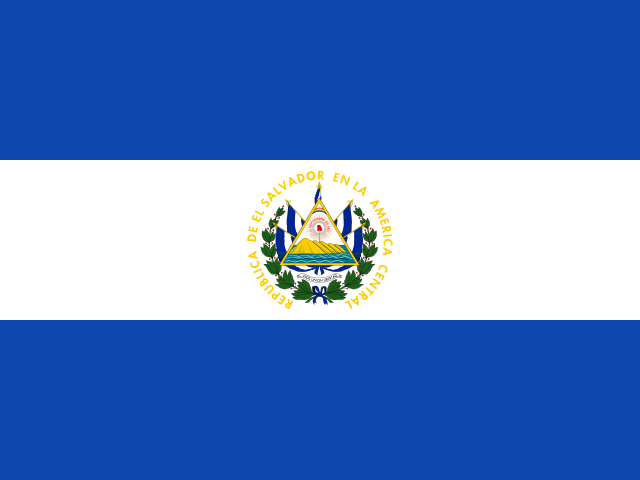
 El Salvador
Comprehensive education database information
Education System in El Salvador
El Salvador, officially known as the Republic of El Salvador, is situated in Central America, bordered by Guatemala and Honduras to the west and east, respectively, and the North Pacific Ocean to the south. With a population of approximately 6.9 million, the nation boasts a literacy rate of around 80.2%. The official language is Spanish, while Nahua is also widely spoken. The country has a rich historical background, marked by Spanish colonization in the early 16th century and subsequent independence from Spain in 1821. Following a tumultuous history of civil unrest and a civil war that lasted from 1979 to 1991, El Salvador has maintained relative stability since the signing of peace accords.
Overview of the Education System
The educational framework in El Salvador is designed to provide free and compulsory education for children aged 6 to 15. This system is overseen by the Ministerio de Educación (Ministry of Education) and is organized into several levels, including primary, secondary, and post-secondary education. Education is a cornerstone for many families, especially those seeking to improve their socio-economic conditions. However, significant challenges remain, particularly in terms of educational quality and access between urban and rural areas.
Primary Education
Structure and Duration
- Enrollment Age: Children generally begin primary education at age 7 after completing optional kindergarten.
- Duration: This stage spans 9 years, divided into three cycles of 3 years each.
- The third cycle acts as a bridge to secondary education.
Challenges
The quality of education in rural areas tends to be lower than in urban settings, resulting in disparities in learning outcomes for students.
Secondary Education
Overview
- Duration: Following primary education, students engage in secondary education, which lasts for an additional 2 years.
- Qualifications: Upon completion, students are awarded a general bachelor's degree, similar to a high school diploma.
Specialization Options
Students who do not intend to pursue university education have the option to extend their studies for another year to obtain a technical bachelor's degree. This program includes specialized training in various fields, such as:
- Accountancy
- Computer Science
- Secretarial Services
Vocational Education
Providers and Oversight
Vocational training primarily takes place in private colleges and is supervised by the Salvadorian Vocational Training Institute. This institution aims to:
- Enhance the knowledge base of the workforce
- Improve the living standards of workers and their families
Tertiary Education
Institutions and Programs
El Salvador hosts 23 universities, which encompass both secular and religious institutions.
- Degree Duration: A typical bachelor's degree requires 4 to 5 years of study.
Advanced Studies
After obtaining a bachelor's degree, students can pursue further education in master's and doctorate programs.
Notable Institutions
- El Salvador University, established in 1841, is the oldest university in the nation. Founded through a collaboration between a military general and a priest, the university has faced numerous challenges throughout its history, including periods of conflict. Recently, it has worked in partnership with the government to secure funding and support for its programs.
In conclusion, the education system in El Salvador is characterized by its commitment to providing accessible education across various levels. While strides have been made to enhance educational opportunities, ongoing efforts are necessary to address the disparities that persist, particularly in rural areas.