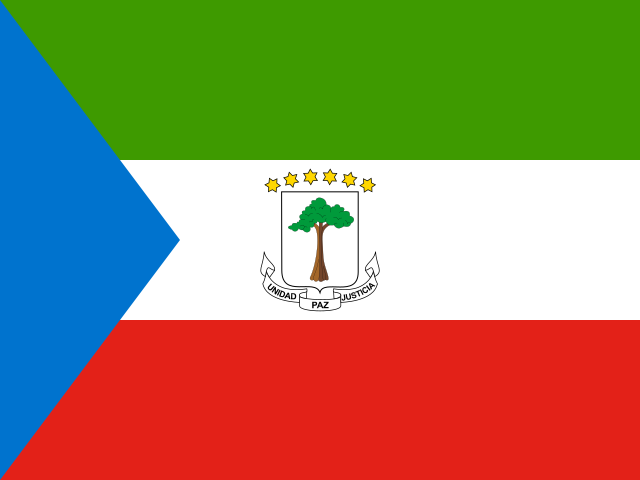
 Equatorial Guinea
Comprehensive education database information
Education System in Equatorial Guinea
Equatorial Guinea, officially known as the Republic of Equatorial Guinea, is a nation situated along the west-central coast of Africa. It shares borders with Cameroon and Gabon, and has access to the Gulf of Guinea. The country encompasses both mainland territory and several inhabited islands. With a relatively small population of approximately 616,459, it ranks as the third least populated country on the African continent. The literacy rate in Equatorial Guinea stands at a commendable 87%.
Spanish is the primary official language, spoken by around 68% of the population, and serves as the main language of instruction in schools. French is also recognized as an official language, with about 30% of the populace using it.
Overview of the Education System
The education system in Equatorial Guinea is structured to offer free and compulsory education for children between the ages of 6 and 11. It consists of multiple levels that prepare students for both academic and vocational pathways. The system emphasizes foundational skills in primary education, followed by more specialized training during secondary and post-secondary education.
Primary Education
Structure
- Duration: Primary education lasts for 5 years, commencing at age 6.
- Compulsory: Education is mandatory and free during these years.
Completion
Upon finishing primary school, students are required to take an external examination that leads to the Certificado de Estudios Primarios. Successfully passing this examination allows students to proceed to vocational training options.
Secondary Education
Equatorial Guinea's secondary education is divided into two main stages: lower secondary and upper secondary.
Lower Secondary Education
- Duration: This stage lasts for 4 years.
- Focus: It aims to build on the foundational skills acquired in primary education.
Upper Secondary Education
- Duration: Upper secondary education is divided into two tracks:
- Academic track: This lasts for 3 years and culminates in an external examination that leads to the Bachillerato.
- Vocational track: This includes two cycles:
- First Cycle: A 1-year program leading to the Grado Medio (Mid-Grade).
- Second Cycle: A 2-year program that results in the Grado Superior (Higher Grade).
Post-Secondary Education
Higher Education Institutions
Equatorial Guinea hosts the Universidad Nacional de Guinea Ecuatorial, which was established in 1995. Admission to this institution requires the completion of the Bachillerato.
Program Structure
- First-Level Programs: These programs span 6 semesters and culminate in the Licenciado degree.
- Second-Level Programs: Following the Licenciado, these programs last for 4 semesters and lead to a Master's degree.
- Doctoral Programs: These advanced programs require at least 3 years of coursework and research after obtaining a Master's degree, resulting in a Doctorate.
In summary, the education system in Equatorial Guinea is designed to cater to the diverse needs of its population, offering opportunities for both academic advancement and vocational training. The structure supports a pathway from basic education to higher education, ensuring that students are prepared for the challenges of the modern world.