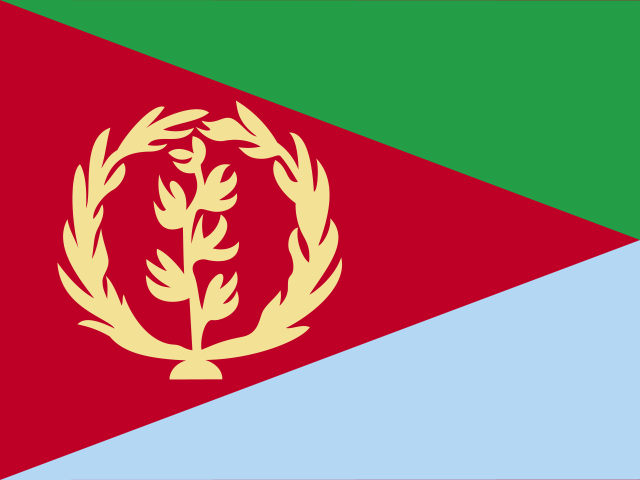
 Eritrea
Comprehensive education database information
Education System in Eritrea
Eritrea, officially known as the State of Eritrea, is located in the northeastern part of Africa, bordered by Sudan, Ethiopia, and Djibouti. The country boasts a population of approximately 5.5 million people and has a literacy rate of 58.6%. Eritrea is home to nine different ethnic groups, with the Tigrinya and Tigre communities forming the majority. The official languages for commerce and governance are Tigrinya and Arabic, while English serves as the medium of instruction in secondary education and at the University of Asmara.
The region has a rich historical background, with evidence of ancient civilizations dating back to 3500 BC. It has experienced various periods of control by different countries and empires. After being colonized by Italy in 1885, Eritrea was placed under British military administration following World War II. A United Nations resolution in 1952 established a federation with Ethiopia, which was subsequently dissolved in 1962 when Emperor Haile Selassie annexed Eritrea. This led to a prolonged struggle for independence, ultimately achieved on May 24, 1993.
Overview of the Education System
Eritrea's education system is diverse and structured to provide a thorough learning experience from early childhood through to higher education. The system emphasizes the importance of education as a fundamental right and aims to cultivate a knowledgeable populace capable of contributing to national development.
Primary Education
-
Preschool Education: The educational journey in Eritrea begins with two years of preschool education, laying a foundation for early learning.
-
Elementary Education: This stage consists of a five-year program starting at age 7. During this period, the mother tongue is utilized as the primary medium of instruction, fostering linguistic skills and cultural identity.
Middle Education
- Middle Level Education: Following elementary education, students transition to middle education, which spans from grades six to eight. At this level, English becomes the medium of instruction, preparing students for future academic challenges.
Secondary Education
-
Duration: Secondary education lasts for a total of four years, culminating in the Eritrean Secondary Education Certificate Examination (ESECE).
-
Specialization: In the last two years (grades 11 and 12), students are guided into specific streams, focusing on either Natural Sciences or Social Sciences, depending on their interests and academic performance.
Vocational Education
Eritrea has been actively enhancing its vocational training programs to meet the needs of the labor market.
-
Significant strides were made in 2010, with training centers accommodating around 27,000 students across various vocational disciplines.
-
Plans are in place to establish additional vocational institutions to further expand access to practical skills training and enhance employability.
Tertiary Education
Eritrea offers a variety of educational opportunities at the tertiary level through several colleges and technical schools. These institutions focus on diverse fields, including:
- Agriculture
- Arts & Social Sciences
- Biology
- Business & Economics
- Nursing & Health Technology
In addition to these colleges, the country is home to two prominent universities:
-
University of Asmara: Founded in 1958 by the Catholic Church, this institution has evolved significantly from its origins as a school for expatriate Italian girls into a national center for higher learning.
-
Eritrean Institute of Technology: A more recent addition to the educational landscape, this institute plays a crucial role in advancing technical education and research in Eritrea.
Teacher Training
To ensure a well-qualified teaching workforce, Eritrea has established specific training programs for educators:
-
Primary School Teachers: These educators undergo a one-year training program at designated teacher training institutes, leading to a Teacher Training Institute Certificate. Admission is contingent upon passing the Eritrean Secondary Education Certificate Examination (ESECE) and an entrance examination.
-
Junior and Senior Secondary Teachers: Candidates aspiring to teach at these levels must possess a bachelor's degree from the College of Education at the University of Asmara, ensuring that they are well-equipped to deliver quality education.
In summary, Eritrea's education system is designed to foster a knowledgeable and skilled population, with a clear pathway from early childhood education through to tertiary and vocational training. The commitment to education as a fundamental right underpins the nation's development goals and aspirations.