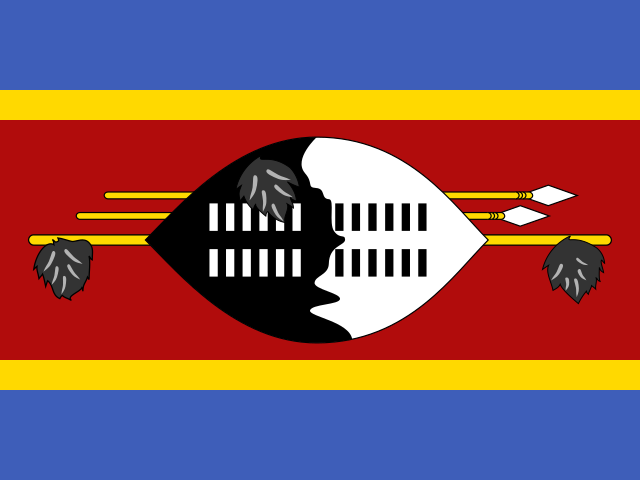
 Eswatini
Comprehensive education database information
Education System in Eswatini
Overview of Eswatini
The Kingdom of Eswatini, formerly known as Swaziland, is a landlocked nation in southern Africa, bordered by South Africa and Mozambique. The country has a population of approximately 1.1 million and a literacy rate of around 81.6%. Both English and Swazi are recognized as the official languages. The region has a rich history of settlement dating back to the Stone Age, and in the early 19th century, King Sobhuza I established the Swazi kingdom. Eswatini became a British protectorate in 1902 and achieved independence on September 6, 1968. The Ministry of Education and Training is responsible for overseeing the country's education system.
Introduction to the Education System
The education system in Eswatini is structured largely on the British educational model while incorporating its own distinctive elements. Education is compulsory and free for children from ages 6 to 13, encompassing both primary and junior secondary education. As students progress through the system, various examinations assess their readiness for the next educational stage.
Levels of Education
Primary Education
- Duration: Primary education spans 7 years, starting at age 6.
- Curriculum: The curriculum comprises a broad range of general subjects aimed at providing a foundational education.
- Examination: Upon completing primary school, students must pass the Swaziland Primary School Certificate Examination to qualify for admission into secondary school, although this transition can be competitive.
Secondary Education
- Enrollment: Only about 20% of students from primary school advance to secondary education, which is neither compulsory nor free.
- Curriculum: The curriculum in secondary schools is designed to prepare students for university:
- The initial 3 years conclude with the Junior Certificate Examination.
- The subsequent 2 years lead to the General Certificate of Education Ordinary Level (O-Level).
- Advanced Education: There are a limited number of institutions, specifically 3 schools, that provide 6th Form A-Level education.
Vocational Education
- Challenges: Many students, especially in rural areas, face significant barriers to continuing their education beyond primary school due to economic constraints, as families often struggle to pay for secondary school fees.
- Distance Learning: To address these challenges, initiatives are being implemented to enhance distance learning, utilizing resources such as the state radio service for educational broadcasts.
- Workforce Needs: For numerous children, primary education marks the end of their formal schooling, as they are expected to support family duties and acquire traditional skills.
Tertiary Education
- Institutions: The tertiary education landscape in Eswatini is limited to a few key institutions:
- Swaziland College of Technology
- University of Swaziland
- Established in 1982 as a national institution through regional cooperation.
- Offers a variety of faculties, including:
- Agriculture
- Commerce
- Education
- Health Sciences
- Humanities
- Applied Sciences
- Social Science
- While primarily focused on undergraduate education, the university also provides postgraduate programs in areas such as agriculture, chemistry, education, and history.
Conclusion
The education system in Eswatini reflects a blend of historical influences and contemporary challenges. While strides have been made in expanding access to education, particularly in primary levels, significant obstacles remain, especially in advancing to secondary and tertiary education. Ongoing efforts to improve educational resources and accessibility, particularly through distance learning initiatives, are essential for fostering a more equitable educational landscape in the country.