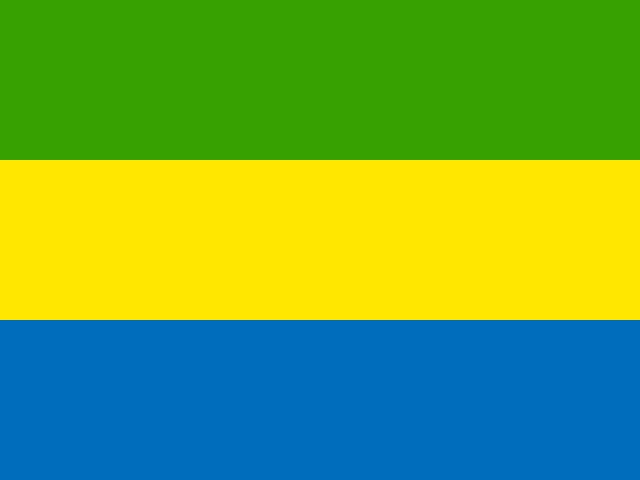
 Gabon
Gabon
Comprehensive education database information
Education System in Gabon
Overview of Gabon
Gabon, officially known as the Republic of Gabon, is situated on the equator in West Africa. It shares borders with Equatorial Guinea, Cameroon, the Republic of the Congo, and the South Atlantic Ocean. With a population of approximately 1.5 million, Gabon boasts a literacy rate of 72%. The region's early inhabitants were primarily Pygmy tribes, later succeeded by Bantu groups who migrated into the area. European exploration began in the 15th century, culminating in Gabon becoming a French colony in 1885 and part of French Equatorial Guinea in 1910. The country achieved independence from France on August 17, 1960.
Introduction to the Education System
The education system in Gabon is largely modeled after the French educational framework and is undergoing progressive changes. Education is mandatory for children between the ages of 6 and 16 years, ensuring access to learning for the majority of the population.
Primary Education
Structure and Duration
- Duration: Primary education spans 6 years.
- Enrollment Age: Children typically start primary school at the age of 6, following attendance at crèche and kindergarten.
Certification and Transition
- Certification: Upon finishing primary education, students are awarded the Certificat d'Études Primaires.
- Transition to Secondary: Admission into secondary education is based on the results of the concours d'entrée en sixième exam.
Secondary Education
Types of Institutions
Gabon’s secondary education encompasses several types of institutions:
- General Secondary Schools
- Technical Secondary Schools
- Private Schools
- International Schools
Structure and Exams
- Duration: The complete secondary education program lasts for 7 years.
- Examinations: After 4 years, students must pass the Brevet d'Études du Premier Cycle examination.
- Graduation: Students graduate from secondary school with a baccalauréat.
Vocational Education
Management and Objectives
- Oversight: Vocational education and adult training programs are administered by the Ministry of Technical Education and Vocational Training.
- Goals: The primary aim is to strategize the re-integration of citizens into vital economic sectors.
Tertiary Education
Institutions and Programs
Gabon is home to various institutions of higher education, including national universities and specialized institutes. The two principal state universities are:
- University of Sciences and Technologies of Masuku
- Omar Bongo University, established in 1978 and located in Libreville.
Academic Faculties
Omar Bongo University offers an array of faculties, such as:
- Administration
- Engineering
- Forestry
- Hydraulics
- Law
- Literature
- Management
- Science
- Teacher Training
Teacher Training Programs
Primary Education
Teachers for primary schools undergo a 4-year training program at teacher training colleges following their lower secondary education, culminating in the Certificat d'Aptitude Pédagogique.
Secondary Education
- Lower Secondary Teachers: Training occurs at the École Normale Supérieure for 3 years, resulting in the Certificat d'Aptitude Pédagogique des Collèges d'Enseignement Général (CAPCEG).
- Upper Secondary Teachers: A 5-year program at the same institution leads to the Certificat d'Aptitude au Professorat de l'Enseignement Secondaire (CAPES).
- Technical Upper Secondary Teachers: These educators are trained at the École Normale Supérieure d'Enseignement Technique, earning their qualification through a similar pedagogical certification process.
In summary, Gabon's education system, influenced by its historical ties to France, provides a structured pathway from primary through tertiary education, ensuring that its citizens are equipped with the necessary skills for personal development and economic participation.