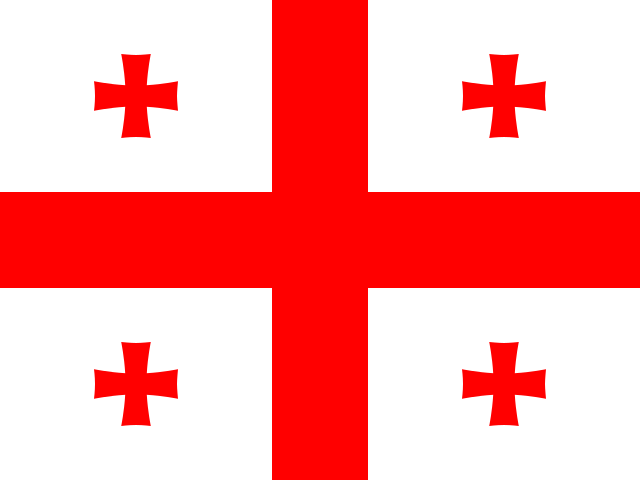
 Georgia
Comprehensive education database information
Education System in Georgia
Georgia, known as Sakartvelo, is situated in the Southern Caucasus region of southwestern Asia. It shares its borders with Russia, Azerbaijan, Armenia, Turkey, and the Black Sea. With a population of approximately 4.6 million people, Georgia boasts a remarkable literacy rate of 100%. The official language is Georgian, spoken by around 71% of the population, while other languages such as Russian, Armenian, and Azeri are also prevalent. The country has a rich historical background, having been influenced by various cultures and empires throughout the centuries, including the Greeks, Byzantines, and Ottomans. After gaining independence from the Soviet Union in 1991, Georgia undertook significant reforms in its educational system starting in 2004, aiming to enhance the quality and accessibility of education.
Overview of the Education System
The education system in Georgia is organized into several distinct levels, which include primary, middle, secondary, vocational, and tertiary education. The system is designed to ensure that all children receive a comprehensive education that prepares them for future academic and professional pursuits.
Primary Education
- Mandatory Age: Education is compulsory for children aged 6 to 14.
- Duration: The primary education phase consists of 6 years of elementary schooling, commencing at age 6.
- Academic Calendar: The school year typically runs from September to June, with flexibility for the head teacher to adjust breaks for winter and harvest seasons.
Middle Education
- Structure: Middle education covers grades 5 through 9.
- Completion Age: Students generally complete this stage by the age of 15, at which point they can opt to take the arasruli sashulo ganaltebis motsmoba certificate. Education becomes non-compulsory thereafter.
Secondary Education
- Final Stage: The last 3 years of secondary education can be pursued at either:
- Academic Secondary Schools
- Technical Special Secondary Schools
- Graduation Requirements: At around age 18, students are required to take examinations that lead to:
- sashualo ganatlebis atestasi (academic certificate)
- sashualo profesiuli sastsavleblis diplomi (technical diploma)
Vocational Education
- Training Options: Students have access to ongoing vocational training and can enroll in 2-year professional programs.
- Certification: Successful completion of these programs results in the awarding of diplomas, which also allows students to apply for further education at the tertiary level.
Tertiary Education
- Institutions: Georgia is home to over 20 public higher education institutions along with numerous private colleges.
- Degree Types: The higher education framework includes bachelor’s, master’s, and doctoral degrees.
- Notable Institution: The oldest and most prestigious institution is Ivane Javakhishvili Tbilisi State University, founded in 1918, which serves over 20,000 students across various branches throughout the country.
- Faculties Offered: The university provides a wide array of study areas, including:
- Exact & Natural Sciences
- Humanities
- Social & Political Sciences
- Economics & Business
- Law
- Medicine
Recent Reforms and Developments
Since the reforms initiated in 2004, several key changes have been implemented to improve the quality and accessibility of education in Georgia. These reforms have focused on:
- Enhancing the functioning and quality of educational institutions.
- Improving access to education and funding for students.
- Establishing transparent accountability systems.
- Reducing corruption within the education sector.
Georgia joined the Bologna Process in 2005, leading to significant changes in higher education practices. The establishment of the National Education Accreditation Center (NEAC) in 2006 has been vital for assuring the quality of educational programs across both public and private institutions.
The introduction of the Unified National Examinations has helped standardize the admissions process for higher education, ensuring that all students have equal opportunities based on merit. Additionally, the implementation of the European Credit Transfer System (ECTS) is aimed at facilitating student mobility and improving the recognition of qualifications.
In conclusion, Georgia's education system has undergone transformative changes aimed at fostering a more equitable and high-quality learning environment for its citizens. The commitment to continuous improvement reflects the nation's dedication to providing its youth with the skills and knowledge needed to thrive in a rapidly evolving global landscape.