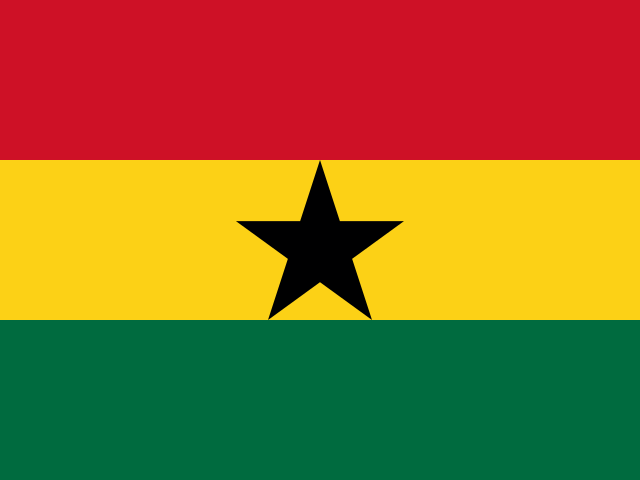
 Ghana
Ghana
Comprehensive education database information
Education System in Ghana
Ghana, a West African nation with a population of approximately 34.7 million as of 2024, has a rich history of education that dates back to the 18th century. This tradition began when Ghanaians who studied in Europe returned home, bringing with them the ideals of formal education. Over the years, the educational landscape in Ghana has evolved significantly, with a structured system that aims to provide quality education to its citizens.
The Ghanaian education system is designed as a 6-3-3-4 structure, which includes six years of primary education, followed by three years of Junior High School (JHS), three years of Senior High School (SHS), and four years of university education to obtain a Bachelor's degree. In recent years, the role of private international schools has increased, offering diverse curricula such as Cambridge A-Levels and the International Baccalaureate.
Overview of the Education Structure
The education system in Ghana comprises various levels of learning, ensuring a pathway from early childhood education through to tertiary education.
Primary Education
- Duration: Primary education lasts for 6 years, commencing at around six years of age.
- Cost: This level of education is free for all students, although families may opt for private schooling if they prefer.
- Curriculum: Students complete six grades, focusing on foundational subjects that prepare them for further education.
Middle Education (Junior High School)
- Duration: After completing primary education, students progress to Junior High School for an additional 3 years.
- Curriculum: The JHS curriculum encompasses a range of subjects, including:
- Ghanaian Language
- Basic Design and Technology
- English Language
- French Language
- Information Technology
- Integrated Science
- Mathematics
- Social Studies
- Moral Education
- Quality Disparity: There exists a significant disparity in educational quality between private and public junior high schools, with private institutions generally offering superior resources and outcomes.
Secondary Education
- Admission: Students who successfully complete Junior High School are eligible to enter Senior High School.
- Duration: The SHS program spans 3 years and is predominantly comprised of state-owned schools.
- Core Curriculum: During these three years, students study essential subjects such as:
- English
- Mathematics
- Science
- Social Studies
- Physical Education
- Specialization: Students can choose to specialize in one of the following fields:
- Agriculture
- Business
- General Arts
- Science
Vocational Education
- Recent Developments: Ghana has made strides in enhancing its vocational education programs, catering to students aged 16 and older who wish to pursue practical and professional training.
- Infrastructure: The establishment of new vocational schools and the introduction of additional courses aim to address the increasing demand for skilled labor in the country.
Tertiary Education
- Duration: Tertiary education typically requires a commitment of 4 years to achieve a Bachelor's degree.
- Access: Admission to universities is competitive, with the most academically successful students attending state universities, which offer nominally free education. Others may seek education at private institutions, which charge tuition.
- Post-Graduate Opportunities: A wide range of post-graduate programs is available, allowing for further academic advancement.
- Historical Context: The University of Ghana, founded in 1948, was established as the University College of the Gold Coast by colonial authorities. It has since evolved to offer both traditional degrees and vocational training tailored to contemporary job markets.
In summary, Ghana's education system reflects its historical roots and ongoing development, striving to provide accessible and quality education at every level. Through its structured approach, the nation aims to equip its citizens with the knowledge and skills necessary for personal and professional success.