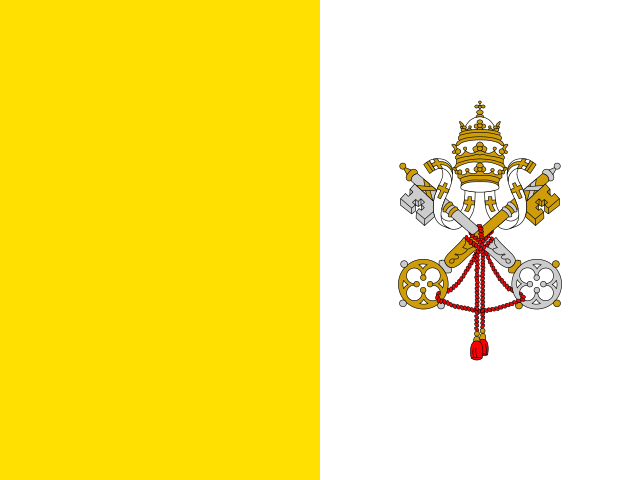
 Holy See
Comprehensive education database information
Education System in Holy See
Overview of the Holy See
The Holy See, also known as Vatican City, is a sovereign city-state situated entirely within the city of Rome, Italy. It is recognized as the world's smallest independent state, covering an area of just 44 hectares. With a population of approximately 824 residents, the Holy See is primarily known as the spiritual and administrative center of the Roman Catholic Church. The official languages spoken here include Italian, Latin, and French. Historically, the Papal States, governed by the Popes for nearly a millennium, were absorbed into the Kingdom of Italy in the mid-19th century. The establishment of Vatican City as an independent state was formalized through the Lateran Treaties in 1929, which also granted the Holy See authority over several important sites in Rome and beyond.
Introduction to the Education System
The education system in the Holy See is distinct and primarily oriented towards post-secondary education. It emphasizes fields such as theology, philosophy, psychology, religion, canon law, and social sciences. The curriculum is predominantly delivered in Italian and Latin, and the education system is overseen by the Congregazione per l’Educazione Cattolica della Santa Sede. Given the unique context of Vatican City, particularly the celibacy of its clergy, there is no traditional primary education within its borders.
Education Levels in the Holy See
Primary Education
Vatican City does not provide primary education in the conventional sense due to its specific governance and demographic constraints. Key aspects of primary education include:
- Geographical Limitations: With its limited area, Vatican City lacks the necessary space for educational facilities.
- Small Resident Population: The small population renders the establishment of local schools impractical, especially when educational options are readily available in nearby Rome.
- Support for External Institutions: The Holy See endorses approximately 64 educational institutions located in Rome and other parts of the world, ensuring access to education for children of its clergy and those affiliated with the Church.
Post-Secondary Education
The Holy See's education system is primarily focused on post-secondary education, structured into three distinct cycles:
First Cycle
- Duration: This cycle lasts for three years.
- Admission Requirements: To enter the first cycle, students must have completed secondary education. Some programs may require additional qualifications, such as proficiency in philosophy and language studies.
- Awards: Upon successful completion, graduates receive a Baccalaureato or Baccellierato. Certain institutions may grant a diploma following the submission of a comprehensive paper.
Second Cycle
- Duration: The second cycle encompasses two years of further study.
- Admission Requirements: Enrollment requires a prior Baccalaureato or Baccellierato.
- Awards: Successful students are conferred a Licenza or Laurea Specialistica upon completion.
Third Cycle
- Duration: This final cycle involves 2-3 years of advanced research or coursework.
- Requirements for Graduation: Students must defend a dissertation successfully.
- Awards: Graduates receive a Dottorato, marking the culmination of their academic journey.
Curriculum
The curricula implemented in the Holy See's educational institutions are generally aligned with the educational policies of the host countries. However, they also place a significant emphasis on faith-based instruction, reflecting the values and teachings of the Catholic Church.
Challenges in Education
In modern society, the role of religion within the educational framework is evolving. As secularism grows, concerns arise regarding the sustainability of faith-based educational institutions, particularly in lower-income areas. The closure of Catholic schools could greatly affect educational opportunities in these regions, underscoring the vital role that such institutions play in providing education.
Conclusion
The education system in the Holy See is uniquely shaped by its historical, cultural, and demographic context. While it lacks a traditional primary education system, it offers a structured post-secondary curriculum focused on theological and philosophical studies, contributing to the broader mission of the Roman Catholic Church. The challenges facing faith-based education in a rapidly changing world highlight the importance of maintaining these institutions for future generations.