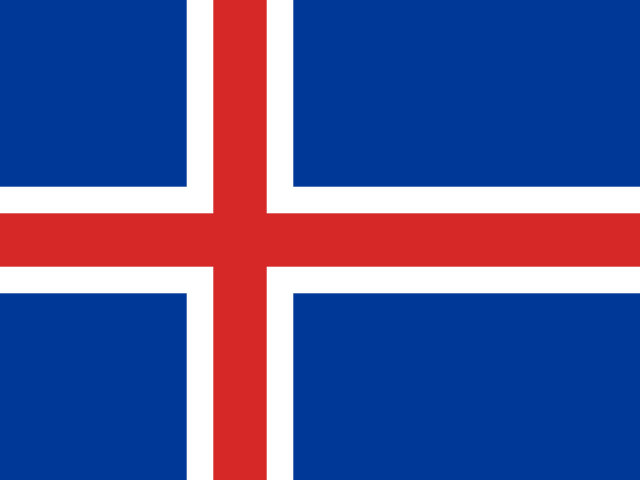
 Iceland
Comprehensive education database information
Education System in Iceland
Iceland, a Nordic island nation situated in the North Atlantic, boasts a rich history that dates back to its settlement by Norwegian and Celtic immigrants in the 9th and 10th centuries. The country is unique, being the westernmost point of Europe and characterized by its stunning natural landscapes, including glaciers and volcanoes. Following centuries of rule by Norway and Denmark, Iceland gained full independence on June 17, 1944. The primary language spoken is Icelandic, with English also being widely used in educational contexts. Education is highly valued in Iceland, as evidenced by the country's impressive literacy rates and its citizens' voracious reading habits.
Overview of the Education System
Iceland's education system is designed around the Nordic education model and is organized into four primary phases: playschool, basic compulsory education, upper secondary education, and higher education. The majority of educational institutions in the country are publicly funded, reflecting the government's commitment to providing accessible education for all.
Education Levels
Primary Education
- Basic Compulsory Education:
- Commences at the age of 6 and spans a total of 10 years.
- Upon successful completion, students receive the Grunnskólapróf certificate, which is based on assessments carried out within the schools.
Secondary Education
- Voluntary Upper Secondary Education:
- Lasts for 4 years.
- Offers three distinct pathways:
- Comprehensive Secondary Schools (menntaskólar)
- Industrial Vocational Schools (iðnmenntaskólar)
- Specialized Vocational Schools (sérskólar), focusing on specific trades and skills.
Vocational Education
- Lifelong Adult Education:
- Available through various independent institutions.
- Courses range from basic literacy to advanced computer literacy, catering to diverse learning needs.
Tertiary Education
- In Iceland, higher education institutions are referred to as háskóli, meaning high school.
- The education system does not differentiate between traditional universities and institutions lacking research facilities.
- There are a total of 8 tertiary institutions, with the University of Iceland, founded in 1911, being the oldest and largest.
- The University of Iceland provides instruction across 25 campuses, encompassing a variety of fields, including:
- Humanities
- Natural Sciences
- Social Sciences
- Professional disciplines such as:
- Theology
- Law
- Business
- Medicine
- Pharmacology
- Dentistry
- Nursing
- Engineering
Degree Programs
First Cycle
- Offers various undergraduate degrees, including:
- Bachelor of Arts (Baccalaureatus artium)
- Bachelor of Science (Baccalaureatus scientiarum)
- Bachelor of Education (Baccalaureatus educationis)
- Most of these programs typically last for 3 years, while degrees in nursing and physical therapy require 4 years.
Second Cycle
- Graduate programs prepare students for professional careers.
- Degree duration varies:
- 1.5 to 2 years for students holding a bachelor’s degree.
- 4 to 6 years for those who have completed the stúdentspróf.
- Awards include the kandidatspróf (candidatus) or a meisterapróf (master's degree).
Third Cycle
- Doctoral programs require completion of coursework and a dissertation defense.
- Admission typically necessitates a kandidatspróf, meisterapróf, or an equivalent qualification.
- Upon completion, students are awarded the doctorspróf or doctor philosophicus.
Conclusion
The education system in Iceland reflects a strong commitment to providing accessible and quality education for all citizens. From early childhood education through to higher education, Iceland emphasizes literacy and lifelong learning, ensuring that its population is well-prepared for the demands of the modern world. The structure of the education system supports various pathways, catering to the diverse needs of students and fostering a culture of learning and intellectual growth.