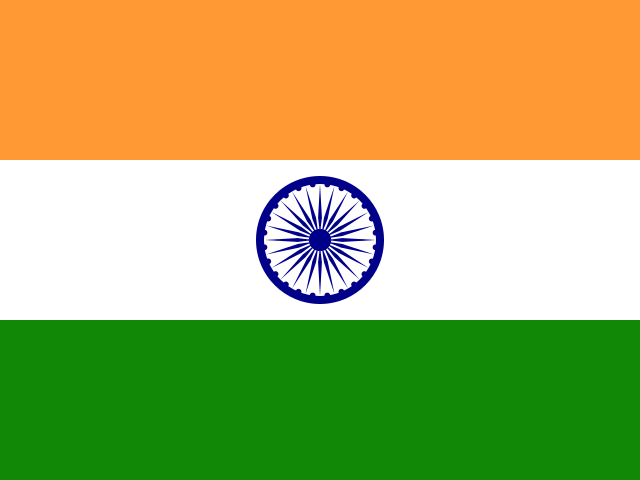
 India
India
Comprehensive education database information
Education System in India
India, a country known for its rich cultural heritage and diversity, has a multifaceted education system influenced by various historical and socio-economic factors. The education system is primarily modeled on the British system and operates under a dual governance structure involving both state and federal authorities. While the state governments manage the organization and delivery of education, the federal government ensures that educational standards are upheld across the country.
Free and compulsory education is guaranteed for children up to the age of fourteen, setting a foundation for lifelong learning. The education system in India is categorized into three main streams: school education, higher education (including colleges), and non-university education.
Primary Education
Primary education in India is both mandatory and free, covering lower primary (Standards I to V) and upper primary (Standards VI to VIII) levels. Important aspects include:
- Age Requirement: Children typically begin their primary education at the age of 6, which continues until they reach 14 years of age.
- Types of Schools: The education is delivered through a mix of state-run and private institutions. However, private schools often face challenges such as inadequate facilities compared to government schools.
- Medium of Instruction: Instruction is primarily conducted in the regional language, with English introduced as a second language by grade 3.
Secondary Education
Secondary education encompasses grades 9 to 12 and is divided into two phases:
- Lower Secondary: This includes grades 9 and 10.
- Upper Secondary: This consists of grades 11 and 12.
Key Features
- Free Education: Government schools continue to offer free education at this level, while private schools are more common.
- Public Examinations: At the conclusion of both lower and upper secondary education, students take public examinations that determine eligibility for higher studies.
- Curriculum: The lower secondary curriculum typically includes:
- Three languages (regional, an elective, and English)
- Mathematics
- Science and Technology
- Social Sciences
- Work/Pre-Vocational Education
- Arts
- Physical Education
Upper Secondary School
Access to upper secondary education is contingent on performance in lower secondary and public examination results. Key features include:
- Stream Selection: Students may choose to focus on specific areas such as:
- Science
- Commerce
- Arts/Humanities
- Types of Institutions: Education is provided through schools or two-year junior colleges, often linked to degree-awarding universities.
- Examinations: The curriculum for the Higher Secondary Certificate Examination (HSCE) is set by various education boards, with several examinations available, including:
- All India Senior School Certificate (CBSE)
- Indian School Certificate
- Certificate of Vocational Education (CISCE)
- Senior Secondary Certification (NIOS)
Vocational Education
Vocational education is designed for young people who choose not to pursue traditional tertiary education or who may not complete secondary education. Key features include:
- Institution Type: Students often attend privately-owned vocational schools that offer specialized courses.
- Curriculum: The curriculum provides practical knowledge and skills relevant to employment, including:
- Language courses
- Foundation courses
- Electives, with a significant portion being practical
- Examinations: Assessments are conducted by both the All India and State Boards of Vocational Education.
Tertiary Education
India's higher education system has undergone substantial transformation since its independence in 1947, largely reflecting the British educational framework.
Governance and Accreditation
- University Grants Commission (UGC): This body oversees the development of higher education, allocates funding, and recognizes institutions.
- National Accreditation and Assessment Council (NAAC): Established by the UGC, NAAC assesses the quality of universities and colleges, employing an alphabetical ranking system from A++ to C. Participation in accreditation is voluntary.
- All-India Council of Technical Education (AICTE): This council regulates technical education quality and oversees the establishment of new private colleges.
Types of Tertiary Institutions
- Universities: There are various types of universities, including Central, State, Open, Institutions of National Importance, and Deemed universities.
- Affiliated Colleges: Approximately 80% of students pursue their education in affiliated colleges, where the university sets the curriculum, examinations, and final degrees.
- Constituent and Autonomous Colleges: These institutions enjoy greater flexibility in curriculum design and assessment, although they are less common.
Admission and Degree Programs
- Undergraduate Admission: Generally requires completion of Standard XII, with admissions based on examination performance.
- Degree Duration:
- Bachelor's Degrees: Usually last three years in fields such as arts, science, social studies, and commerce.
- Diploma Programs: Typically range from 2 to 3 years, often in specialized engineering or technical fields.
- Professional Bachelor's Degrees: In fields like Medicine, Architecture, and Law, these programs range from 4 to 5.5 years.
Graduate and Doctoral Programs
- Graduate Programs: Admission requires a bachelor's degree (either 3 or 4 years), with popular non-university options in Management offering Post Graduate Diplomas equivalent to an MBA.
- Doctoral Degrees: These programs demand a minimum of two to three years of research, culminating in a thesis or dissertation.
Recent Reforms
The Choice Based Credit System (CBCS) was introduced in 2015 to promote an interdisciplinary educational approach and provide flexibility to students. This reform also implemented a standardized assessment and grading framework based on a 10-point scale, although it has faced criticism regarding the educational infrastructure's ability to support these changes.
In conclusion, the education system in India is vast and complex, characterized by a blend of traditional and modern educational practices. It plays a crucial role in shaping the future of the nation by equipping students with the necessary skills and knowledge to thrive in a rapidly changing world.