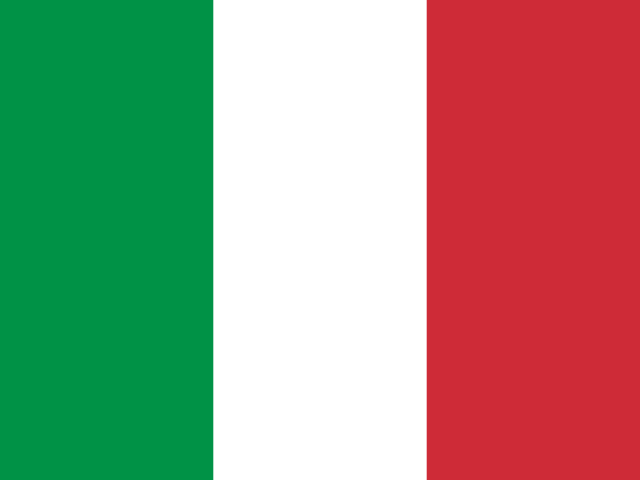
 Italy
Italy
Comprehensive education database information
Education System in Italy
Italy, a nation renowned for its rich historical and cultural heritage, has a complex and multifaceted education system that mirrors its diverse societal landscape. With roots tracing back to ancient civilizations, education in Italy has evolved significantly over the centuries. Today, the Italian education system strives to balance a rigorous academic tradition with the demands of modern society, encompassing a range of educational levels and institutions.
Overview of the Education System
The Italian education system is organized into distinct stages, each characterized by specific objectives and curricula. The system emphasizes the importance of foundational education, vocational training, and higher education, aiming to equip students with the skills and knowledge necessary for personal and professional development.
Primary Education
-
Preschool (Scuola Materna):
- Precedes primary education, allowing children to develop social skills and foundational knowledge.
-
Primary School (Scuola Primaria):
- Duration: 5 years.
- Curriculum: Students are introduced to essential subjects, including:
- Computer studies
- English language
- Geography
- Italian language and literature
- Mathematics
- Music
- Science
- Social studies
- Optional religious studies
- Fees: Primary education is provided at no cost, but parents may incur fees until their children reach the age of 16.
- Transition: Children who turn 13 within the academic year are automatically promoted to the next educational stage, which is lower secondary school.
Middle Education
- Lower Secondary School (Scuola Media):
- Mandatory Attendance: Schooling is compulsory but not free.
- Duration: 3 years, generally for students aged 11 to 14.
- Minimum School Hours: Students engage in a minimum of 30 hours of instruction per week, with the option of additional hours funded by the school for subjects such as:
- Computer skills
- Foreign languages
- Sports
- Music (including instrument instruction)
- Chess
- Certification: Upon successful completion of the final year, students receive the Diploma di Licenza Media after passing both oral and written examinations.
Secondary Education
- Upper Secondary School (Scuola Superiore):
- Structure: Comprises two mandatory years followed by an optional three years.
- Options: Students can select from various educational paths, including:
- Liceo: Comparable to grammar schools in other countries, focusing on academic subjects.
- Instituto: Vocational schools that offer practical skills training.
- Types of Secondary Schools: Seven categories are available, including:
- Classical high schools
- Scientific high schools
- Fine arts high schools
- Teacher training schools
- Artistic schools
- Technical institutes
- Professional institutes
Vocational Education
- Further Vocational Education:
- Provides targeted, practical training aligned with European Union standards. This approach enhances the employability of graduates and ensures that Italian tradespeople and technicians possess highly sought-after skills in the global market.
Tertiary Education
-
University System:
- Italian universities adhere to established tertiary education norms, offering a variety of degree programs, including:
- Bachelor's degrees
- Master’s degrees (both 1- and 2-year programs)
- Doctorates
- Specialization Schools: These institutions offer advanced studies for individuals holding second-level degrees.
- Refresher Courses: Known as Corso di Perfezionamento, these programs provide professionals with opportunities to update and enhance their knowledge in a specific field.
- Italian universities adhere to established tertiary education norms, offering a variety of degree programs, including:
-
Historical Significance:
- Italy is home to some of the world’s oldest universities, such as:
- University of Bologna, founded in 1088, which is recognized as the first university in the Western world.
- University of Padua, established in 1222, continues to be a center of academic excellence.
- Italy is home to some of the world’s oldest universities, such as:
In conclusion, the Italian education system is a complex network that caters to a diverse population, ensuring that students receive a comprehensive education that prepares them for both local and global challenges. Through its various stages, from preschool to tertiary education, Italy emphasizes the value of knowledge, cultural heritage, and vocational training, fostering a well-rounded and capable citizenry.