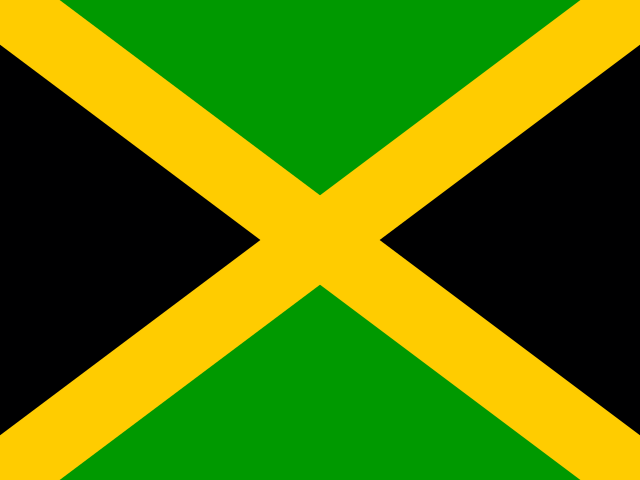
 Jamaica
Comprehensive education database information
Education System in Jamaica
Jamaica, the largest English-speaking island in the Caribbean, measures approximately fifty-two miles in width and 140 miles in length. Historically, it was a British colony from 1655 until gaining independence in 1962, and it remains a member of the British Commonwealth. The island is home to around 2.5 million residents, with English serving as the primary language for instruction and written communication. However, patois, a local dialect, is widely spoken among the populace. The education landscape in Jamaica underwent significant transformations during the 1970s and 1980s, particularly with the introduction of the Programme for the Advancement of Childhood Education (PACE). This initiative aimed to enhance educational opportunities for children across all levels, from pre-primary to university. Although public education is free and compulsory until the age of sixteen, families are responsible for covering costs related to books, uniforms, meals, and transportation, which can hinder school attendance. Enrollment figures reveal a striking contrast, with primary education boasting a 98% enrollment rate compared to only 58% at the secondary level. Class sizes tend to be large, with an average of forty students per classroom.
Overview of the Education System
The education system in Jamaica is structured into several key stages that ensure a continuum of learning from early childhood through to tertiary education. The system comprises primary, secondary, vocational, and tertiary education levels, each designed to cater to the developmental needs of students and the demands of the workforce.
Primary Education
Primary education in Jamaica is both free and compulsory, lasting for a total of six years. Children typically enter primary school at the age of 6 and are expected to complete their education by age 12. Instruction is primarily conducted in English, and schools are categorized into two main types:
- State-owned schools: Funded and managed by the government.
- Private preparatory schools: Independently operated institutions that may charge tuition fees.
Secondary Education
The Jamaican government has launched initiatives aimed at enhancing secondary education to better prepare students for the evolving economic landscape, which increasingly values literacy and mathematics skills. Key initiatives include:
- Upgrading and restocking libraries to enrich learning resources.
- Equipping schools with computers and providing internet access to facilitate digital learning.
Secondary schools are typically categorized as either single-sex or mixed institutions, many of which adhere to the traditional British grammar school model. It is important to note that while education at the primary level is free, secondary education incurs costs once students graduate from primary school.
Vocational Education
Vocational training in Jamaica is managed by the National Training Agency, which coordinates various programs offered by state-run vocational centers and private training institutions. These programs are designed to address the skills needs of the nation and encompass a wide array of fields, including:
- Agriculture
- Automotive technology
- Beauty services
- Clothing manufacturing
- Commercial skills
- Information technology
- Construction and building skills
Tertiary Education
Tertiary education in Jamaica is delivered through a network of five universities alongside numerous community colleges and teacher training institutions, which can be either publicly funded or privately operated. The academic curriculum generally reflects a traditional Western educational model. The key universities include:
- University of the West Indies, Mona Campus
- University of Technology
- College of Art, Science and Technology
- North Caribbean University
- University College of the Caribbean
Conclusion
In summary, Jamaica's education system is a multifaceted framework designed to promote learning from early childhood through to higher education. While significant strides have been made to enhance accessibility and quality, challenges remain, particularly regarding costs associated with secondary education and the need for improved enrollment rates. As the nation continues to develop, ongoing efforts will be crucial in ensuring that the education system meets both the needs of its citizens and the demands of a dynamic global economy.