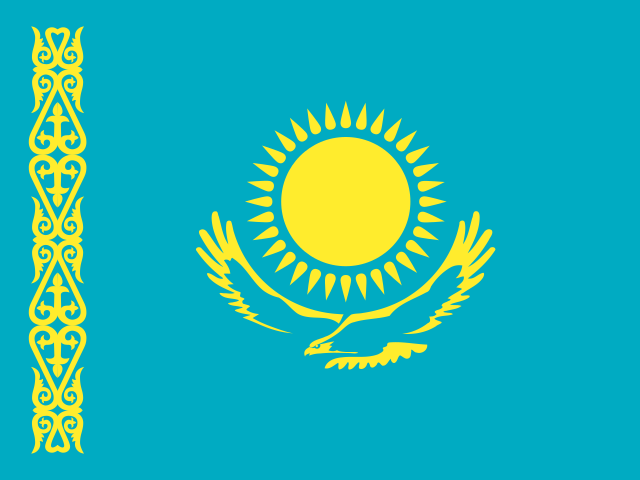
 Kazakhstan
Comprehensive education database information
Education System in Kazakhstan
Kazakhstan, the largest nation in Central Asia, emerged as an independent state following the dissolution of the Soviet Union in 1991. With a vast land area, nearly four times that of Texas, its population is just over fifteen million. The ethnic composition is primarily Kazakh, a blend of Turkic and Mongol heritage, with a significant minority of ethnic Russians. The capital city was relocated from Almaty to Astana, reinforcing ties with Russia. This shift, alongside a rich resource base in oil and gas, has facilitated economic growth, although challenges remain in various sectors, including agriculture and environmental management.
Overview of the Education System
Kazakhstan's education system is marked by its mandatory schooling and boasts a literacy rate exceeding 99%. The framework is centralized under the Ministry of Education and Science, reflecting remnants of its Soviet heritage while also adapting to international standards. The education system comprises several levels, including primary, middle, secondary, vocational, and tertiary education.
Primary Education
Structure and Duration
- Duration: Primary education spans 5 years, starting at the age of 6.
- Organization: Students are typically divided into two groups that attend morning and afternoon sessions to maximize the use of school facilities.
Curriculum
- The curriculum is standardized by the Ministry of Education and applies uniformly to both public and private institutions.
Middle Education
Structure and Duration
- Duration: Middle education lasts for 4 years, culminating in the completion of grade 9.
Curriculum
- The academic program includes a range of subjects:
- Languages: Instruction in either Russian or Kazakh, depending on the region.
- Sciences: Core subjects such as Biology, Chemistry, and Physics.
- Mathematics and Social Studies: Including History.
- Foreign Language: A second language is also part of the curriculum.
Secondary Education
Structure and Duration
- Duration: Secondary education consists of 3 years following middle education.
Pathways
Upon completing middle education, students may choose from three distinct educational paths:
- General Education: Attending a lyceum or gymnasium.
- Vocational Education: Enrolling in a professional lyceum or vocational school.
- Professional Education: Attending a professional college.
Funding
- The majority of educational costs are subsidized by the state, ensuring accessibility for students.
Vocational Education
Kazakhstan is currently enhancing its vocational training framework through the establishment of an ad-hoc training company. This initiative aims to develop a network of institutions that align with the country's industrialization efforts, improving the skill set of the workforce.
Tertiary Education
Kazakhstan's tertiary education landscape is diverse and includes various types of institutions:
- Universities
- Academies
- Institutes
- Higher Schools and Colleges
- Conservatories
Teacher Education
To teach at the secondary school level, educators must obtain a 5-year specialist diploma from a recognized university.
Notable Institutions
-
al-Farabi Kazakh National University: Located in Almaty, it is the oldest university in Kazakhstan, established in 1933. It serves over 20,000 students and employs around 2,500 faculty staff, currently undergoing ambitious expansions.
-
Eurasian National University: Situated in Astana, this institution ranks among the leading universities in the country, known for its academic excellence.
Kazakhstan's education system is in a state of evolution, with ongoing reforms aimed at improving quality and integrating more fully with global educational standards. The anticipated expansion of secondary education to a twelve-year system reflects the nation's commitment to enhancing its educational framework for future generations.