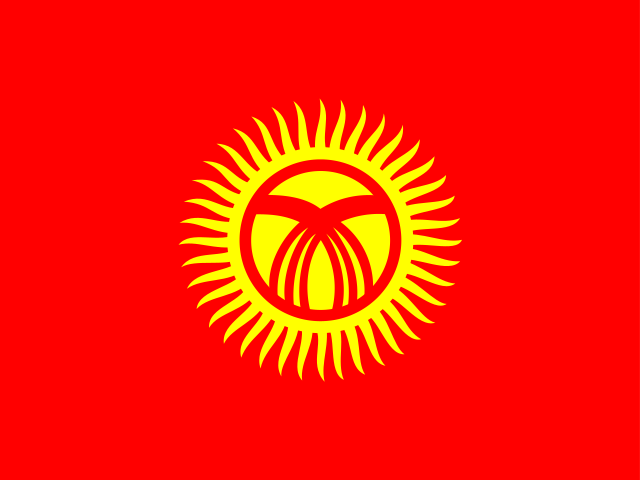
 Kyrgyzstan
Comprehensive education database information
Education System in Kyrgyzstan
Overview of Kyrgyzstan
The Kyrgyz Republic, commonly referred to as Kyrgyzstan, emerged as an independent nation in 1991 following the dissolution of the Soviet Union. The country, characterized by its mountainous terrain, has a rich nomadic heritage, with a population historically organized by clans rather than formal national borders. The influence of the Soviet era is still evident in various aspects of Kyrgyz society, including its education system.
Kyrgyzstan is known for its ethnic diversity, shaped by the Soviet policies that redefined borders and settled various groups in the region. The landscape is primarily agricultural, with animal husbandry being a key industry, alongside the mining of precious metals and hydroelectric energy production. Despite facing economic challenges and social issues such as drug trafficking and ethnic tensions, Kyrgyzstan is gradually moving towards steady economic growth. The official languages are Kyrgyz and Russian, with other languages like Uzbek and English also widely spoken.
Introduction to the Education System
Kyrgyzstan's education system is a legacy of its Soviet past, characterized by a structured approach to learning that is currently undergoing reforms to better align with international standards. The Ministry of Education and Science oversees the entire system, ensuring that education is accessible to all, although challenges remain, especially in early childhood education. While secondary education is free and compulsory, the earlier stages have seen a decline in government support.
Education Levels in Kyrgyzstan
The education system in Kyrgyzstan is segmented into several key stages, including primary, middle, secondary, vocational, and tertiary education.
Primary Education
- Compulsory Duration: Primary education is mandatory for the first 9 years, typically for children aged 7 to 15.
- Initial Enrollment: Children may start their education in either private or state-funded kindergartens prior to entering primary school.
- Structure: Primary education lasts for 4 years, heavily influenced by the Soviet educational model.
Middle Education
- Continuation of Basic Education: After completing primary school, students proceed to middle school for an additional 5 years.
- Objective: The goal of middle education is to prepare students for either further secondary education or direct entry into the workforce.
Secondary Education
- Compulsory Years: The first 2 years of secondary education are compulsory, though many students choose not to continue.
- Streams of Education:
- General Secondary School: Focuses on a broad curriculum.
- Specialized Secondary School: Offers focused education in specific areas of study.
- Vocational/Technical School: Provides practical skills and training for various careers.
- Completion Rates: A limited percentage of the student population successfully completes secondary education.
Vocational Education
- Government Investment: Significant investments have been made in adult education programs to support the transition to a new economic landscape.
- Skill Development: Despite these initiatives, there is a noticeable shortage of skilled labor in the workforce, particularly in this landlocked nation bordering China.
Tertiary Education
- Complex Structure: The tertiary education system encompasses a variety of pathways for students.
- Primary Professional Education: Available through short courses and on-the-job training.
- Secondary Professional Education: Offered by colleges and technicums, which typically last up to 4 years, with a 2-year exemption for individuals who have completed secondary education.
- Higher Education Institutions: This includes academies, institutes, higher colleges, and universities that provide both undergraduate and postgraduate programs.
Notable Institution
One prominent institution is the Kyrgyz State Technical University, established in 1954. It is the oldest university in the country and offers a wide range of faculties, including:
- Information Technology
- Power Engineering
- Transport and Machine Construction
- Technology Management and Business
- Mining and Mountain Technologies
Conclusion
The education system in Kyrgyzstan reflects a unique blend of historical influences and contemporary challenges. While significant strides have been made to improve access and quality, ongoing efforts are crucial to address the gaps in early childhood education and vocational training. As Kyrgyzstan continues to evolve, its education system will play a vital role in shaping the future of its society and economy.