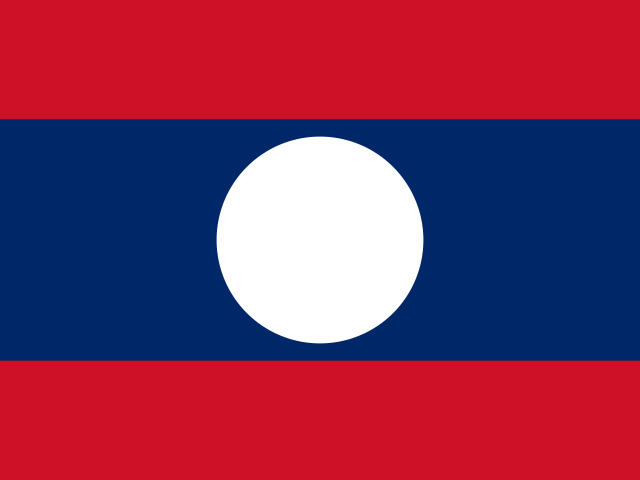
 Laos
Laos
Comprehensive education database information
Education System in Laos
Laos, officially known as the Lao People's Democratic Republic, is a landlocked nation located in Southeast Asia. It shares borders with Thailand, Cambodia, Vietnam, Myanmar, and China. The historical roots of Laos can be traced back to the 14th century with the establishment of the ancient kingdom of Lan Xang by King Fa Ngum. Over the centuries, the region has undergone significant transformations, including periods of Siamese control and later incorporation into French Indochina. After gaining independence from French rule in 1949, Laos experienced a shift in governance when communist forces took control in 1975. The official language is Lao, and while the literacy rate stands at approximately 68%, the nation faces considerable challenges in developing its education system.
Overview of the Education System
The education system in Laos is overseen by the Ministry of Education and Sports, which aims to provide universal access to education for all citizens. However, various obstacles hinder the achievement of this goal, including geographic isolation, cultural factors, and infrastructural limitations. Education in Laos is divided into three main levels: Primary Education, Secondary Education, and Tertiary Education.
Primary Education
- Duration: Primary education in Laos is compulsory and lasts for five years, starting at the age of six.
- Enrollment: Despite being compulsory, only about 71% of eligible children are enrolled in primary schools.
- Certificate: Students who complete primary education receive a Primary School Certificate.
- Challenges:
- Many villages, particularly in remote areas, lack access to primary schools.
- The quality of education is often compromised by insufficient teacher training and inadequate facilities, leading to a disparity in educational outcomes.
Secondary Education
Secondary education in Laos is divided into two stages:
Lower Secondary Education
- Duration: Lasts for three years.
- Certificate: Upon completion, students receive the Diplôme d'Études du Premier Cycle d'Études Nationales (DEPCEN).
- Enrollment Issues: Cultural and linguistic minorities, along with girls, are often underrepresented, perpetuating cycles of structural discrimination.
Upper Secondary Education
- Duration: Also lasts for three years.
- Certificate: Students receive the Baccalauréat II, which qualifies them for university admission.
- Continuation: Typically, only those students planning to pursue higher education complete this stage.
Tertiary Education
Tertiary education in Laos has evolved significantly over the years, originally established during the French colonial period.
- Institutions: The University of Laos, founded in 1996, amalgamated various colleges and institutes to expand access to higher education.
- Program Structure: Tertiary education includes a variety of programs, such as:
- Bachelor's degrees: Require completion of two years at the School of Foundation Studies before advancing to specialized studies.
- Advanced diploma and certificate programs: Offered at higher technical institutes and teacher training colleges.
- Master's degrees: Available in specific fields such as medical sciences and economics, requiring at least two years of study.
- Admission: Entry into universities is regulated by a quota system based on provincial allocations and students' upper secondary performance, with additional aptitude tests determining final admission.
Teacher Training
Teacher training programs vary by educational level:
- Pre-primary and Primary Teachers: Complete a three-year program post lower secondary or a one-year program after obtaining the Baccalauréat II.
- Lower Secondary Teachers: Trained through a three-year course following the Baccalauréat II.
- Upper Secondary Teachers: Required to complete a five-year program at the National University of Laos after finishing their upper secondary education.
Conclusion
The education system in Laos is a work in progress, grappling with challenges related to accessibility, quality, and inclusivity. While the government is making strides to improve educational infrastructure and teacher training, significant gaps remain, particularly for children in rural and marginalized communities. Addressing these issues is crucial for fostering a more equitable and effective education system that can serve the needs of all Lao citizens.