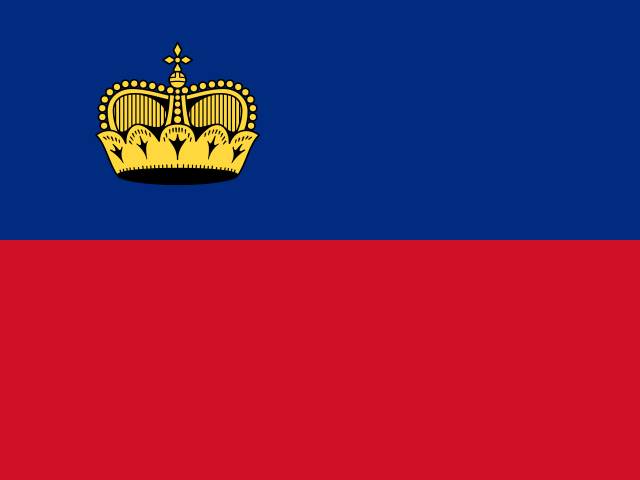
 Liechtenstein
Comprehensive education database information
Education System in Liechtenstein
Overview of Liechtenstein
Liechtenstein, officially known as the Principality of Liechtenstein, is a landlocked nation nestled in Central Europe, bordered by Austria to the east and Switzerland to the west. The country, with a population of approximately 34,498, boasts a remarkable literacy rate of 100%. German is the official language and serves as the primary medium of instruction within the educational system. Established in 1719 and gaining sovereignty in 1806, Liechtenstein joined the Germanic Confederation in 1815, eventually achieving full independence in 1866. The education system is overseen by the Ministry of Internal Affairs, Education, and Environment.
Introduction to the Education System
The educational framework in Liechtenstein is designed to provide a holistic approach to learning, heavily influenced by Catholic educational values. Education is both free and mandatory for children aged 6 to 15. The system is categorized into several key stages: Primary Education, Middle Education, Secondary Education, Vocational Education, and Tertiary Education, ensuring students receive a comprehensive and well-rounded education.
Primary Education
Overview
- Compulsory Education: Initiates at age 6 and lasts for 5 years.
- Kindergarten: Optional pre-primary education is available for younger children before they enter primary school.
- Curriculum: Students receive foundational instruction across various academic subjects, fostering essential skills.
- Certification: At the conclusion of primary education, students are awarded a Grade 5 Certificate.
Middle Education
Middle education comprises three distinct types of institutions tailored to accommodate diverse student needs:
Realschule
- Duration: 4 years
- Focus: Emphasizes practical knowledge and skills, preparing students for vocational paths.
Oberschule
- Duration: 4 years
- Focus: Functions similarly to grammar schools, offering a more academic curriculum to prepare students for further education.
Gymnasium
- Duration: 3 years (with an optional fourth year)
- Focus: Provides a rigorous academic curriculum aimed at preparing students for university-level education.
All middle education programs culminate in the awarding of a Lower Secondary School Certificate.
Secondary Education
Secondary education primarily paves the way for university admission, predominantly through the Gymnasium program. Students aged 15 to 18 participate in an additional 4 years of study:
Specialization
- Students can select from five distinct programs that align with their individual interests and career aspirations.
Certification
- Successful completion of the Gymnasium leads to the Matura Certificate, qualifying students for university enrollment in:
- Switzerland
- Austria
- University of Tübingen in Germany
An alternative route is provided by the Berufsmittelschule, which focuses on vocational education, allowing students to pursue careers in fields such as:
- Business
- Design
- Engineering
- Information Technology
Graduates from vocational pathways receive the Berufsmaturitätsprüfung Certificate, facilitating further studies in neighboring countries.
Vocational Education
For students who choose not to pursue upper secondary education, an optional 10th grade is available to help prepare them for their future careers:
Core Program
- The curriculum encompasses traditional and modern languages, arts, music and pedagogy, business and law, as well as mathematics and natural sciences.
Certification
- Completion of this program results in the awarding of a Senior Secondary Leaving Certificate.
Tertiary Education
While Liechtenstein does not have a full-fledged university, it provides several institutions for higher education, including:
- An evening technical school
- A music school
- A day school focused on children's pedagogic and welfare studies
To facilitate access to higher education, the government has established a set of contractual obligations and a state subsidy scheme that encourages promising students to pursue bachelor’s, master’s, and doctoral degrees at universities in:
- Switzerland
- Austria
- University of Tübingen in Germany
This systematic approach ensures that the small, independent nation of Liechtenstein maintains accessible academic opportunities for all its youth, supporting their academic and professional aspirations.