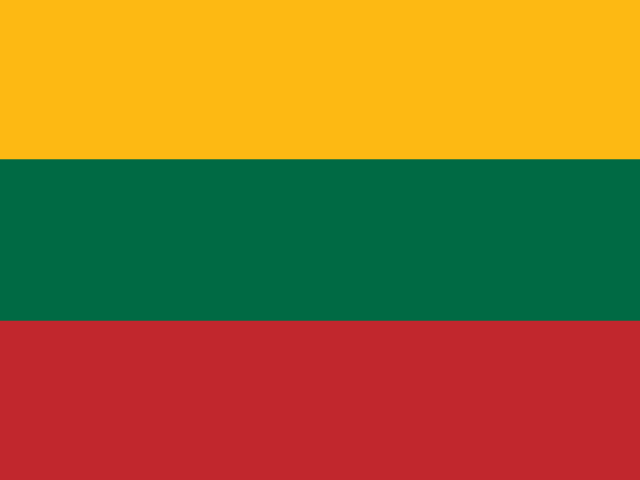
 Lithuania
Comprehensive education database information
Education System in Lithuania
Lithuania, a northeastern European country with a population of approximately 3.76 million, boasts a beautiful 80-mile coastline along the Baltic Sea and shares its borders with Poland, Latvia, and Belarus. The region's history dates back to the arrival of the Balts around 2000 BC, who eventually formed tribal groups by the 12th century AD. Throughout its history, Lithuania has experienced significant political changes, including its conversion to Christianity in the late 14th century, a union with Poland in 1569, and several occupations, culminating in its eventual independence from the Soviet Union in 1990. Today, Lithuania is a member of both NATO and the European Union and has a robust educational framework, including notable institutions like the University of Vilnius, established in 1579.
Overview of the Education System
The education system in Lithuania has seen considerable reforms since 2003, evolving to meet contemporary needs and standards. The structure is divided into several educational levels: Primary Education, Middle Education, Secondary Education, Vocational Education, and Tertiary Education. Each stage plays a crucial role in molding students into competent individuals ready to contribute to society.
Primary Education
- Duration: The primary education program spans 4 years, catering to children typically aged 6 to 11.
- Accessibility: Education at all state-funded institutions is provided free of charge, with pre-school education being partially subsidized.
- Institution Types: There are specialized primary schools as well as institutions that encompass all educational stages.
Middle Education
- Age Range: Middle education generally serves students from around ages 10 to 17.
- Duration: This level comprises 6 years of education, culminating in the issuance of a certificate of lower secondary education.
- Curriculum Focus: The curriculum at this stage is primarily academic, aimed at preparing students for further education.
Secondary Education
- Final Years: The last 2 years of secondary education allow students to choose between:
- Continuing their general education.
- Enrolling in vocational schools that equip them with skills for entry-level employment.
- Flexibility: With the full implementation of the new state education model, students will have the flexibility to transition between general and vocational education pathways.
Vocational Education
- Secondary Completion: Adults can also complete their secondary education through specially designed classes.
- Support for Troubled Pupils: Youth schools provide resources and training for students facing learning or social challenges.
- Vocational Colleges: A network of vocational colleges offers short-term training programs tailored to various career fields.
Tertiary Education
- Institution Types: Tertiary education is categorized into:
- Non-university level colleges
- Universities
- Program Assessment: All educational programs undergo annual evaluation by the Ministry of Education and Science to ensure quality and relevance.
- National Credit System: The education framework operates on a national credit system, allocating 1600 hours per year for academic activities.
- Degree Progression: Pathways from bachelor's degrees to master's and subsequently to doctorates are rigorously structured, prohibiting any shortcuts in degree attainment.
- Historical Institution: The University of Vilnius, founded in 1579 as a Jesuit Academy, stands as the most prestigious institution in Lithuania. After a challenging history in the late 20th century, the university has successfully revitalized its educational offerings.
In conclusion, Lithuania's education system is characterized by its structured approach, accessibility, and commitment to quality. With continuous reforms and a clear progression from primary through tertiary education, Lithuania is dedicated to fostering a knowledgeable and skilled populace equipped to thrive in an ever-evolving global landscape.