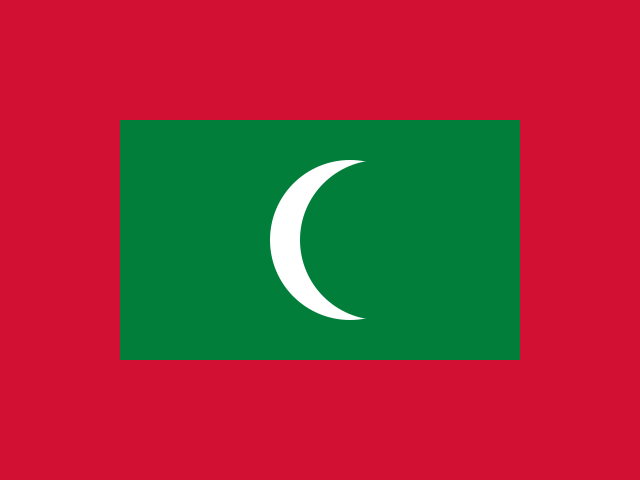
 Maldives
Comprehensive education database information
Education System in Maldives
The Republic of Maldives is an archipelago comprising 26 atolls situated in the Indian Ocean, south-southwest of India. With a population of approximately 385,925, it is recognized as the smallest Asian nation both in area and population. The Maldives boasts a high literacy rate of 96.3%, indicative of its commitment to education. The official language is Maldivian Dhivehi, which is a dialect of Sinhala and utilizes the Arabic script, while English is commonly spoken, especially in governmental contexts. The history of human settlement in the Maldives dates back to around 300 BC, primarily by fishermen from the Indian subcontinent. Over the centuries, the islands have been influenced by various cultures, including Arab and Tamil traders, leading to the establishment of an Islamic sultanate in 1153 that lasted until 1968. Following a period as a British protectorate, the Maldives gained independence in 1965 and transitioned to a republic in 1968.
The education system in the Maldives is overseen by the Ministry of Education and the Department of Higher Education. It incorporates a variety of educational levels, reflecting both traditional and modern practices.
Structure of the Education System
The Maldivian education system is organized into several key stages:
- Primary Education
- Middle Education
- Secondary Education
- Vocational Education
- Tertiary Education
Primary Education
- Duration: 7 years
- Starting Age: 6 years
Primary education in the Maldives consists of two parallel systems:
- Traditional Islamic Schools: Primarily instruct students in Dhivehi.
- Modern English-Language Schools: Established by the government to enhance educational access and quality.
These initiatives have significantly improved literacy rates across the nation.
Middle Education
- Duration: 3 years
Middle education is compulsory and widely implemented throughout the country. However, there are notable disparities in educational quality between the capital, Malé, and smaller, more remote islands.
Secondary Education
Secondary education is divided into two parts:
- Lower Secondary: Lasts for 3 years, culminating in the Secondary School Certificate (SSC) examination.
- Upper Secondary: Lasts for 2 years, after which students take the Higher Secondary School Certificate (HSSC) examination.
Alternatively, students in British-patterned schools complete primary education in 8 years, followed by 3 years of secondary education, leading to the International General Certificate of Secondary Education (IGCSE) and subsequently, 2 years of upper secondary education culminating in the International General Certificate of Secondary Education Advanced Level (IGCSE A-Level).
Vocational Education
The Maldivian government promotes vocational education through a program known as Second Chance, aimed at youth and adults who have not completed their formal schooling. This initiative provides opportunities for individuals to acquire essential skills and qualifications, ensuring that all members of society have the chance to succeed.
Tertiary Education
The Maldives National University, established in February 2011, evolved from the Maldives College of Higher Education and serves as the primary institution for higher education. Located on the main island of Malé, the university offers a diverse range of academic departments including:
- Arts
- Education
- Engineering Technology
- Health Sciences
- Hospitality & Tourism Sciences
- Islamic Studies
- Management & Computing
- Shari’ah & Law
Additionally, the university features specialized centers for maritime studies and open learning. Currently, approximately 4,000 students are enrolled, with an additional 2,000 participating in short courses, reflecting the growing demand for higher education in the country.
The education system in Maldives is continually evolving, aiming to provide quality education that meets the needs of its diverse population and prepares them for future opportunities.