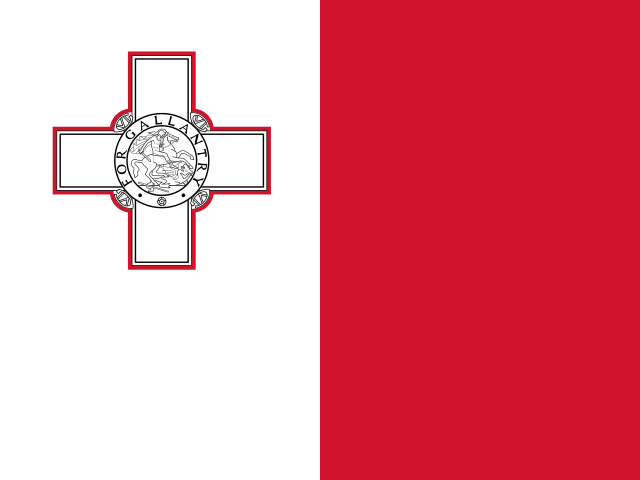
 Malta
Malta
Comprehensive education database information
Education System in Malta
Malta, officially known as the Republic of Malta, is an archipelago comprised of seven islands situated in the southern Mediterranean Sea, just south of Sicily and north of Libya. The two principal islands are Malta and Gozo. With a population of approximately 403,532, Malta boasts a literacy rate of 92.8%. The official languages are English and Maltese, reflecting the country’s rich historical tapestry, which includes periods of settlement and rule by various civilizations, from the Phoenicians and Romans to the Arabs and the British. Education in Malta is both free and compulsory for children between the ages of 5 and 16.
Overview of the Education System
The education system in Malta is organized into several distinct stages: primary education, secondary education, vocational education, and tertiary education. This structured framework is designed to equip students with the essential skills and knowledge required for their future academic and professional journeys.
Primary Education
Structure and Duration
- Primary education in Malta lasts for 6 years, beginning at age 5.
- The educational setting is primarily coeducational.
- The initial 2 years focus on acclimating students to the school environment.
- The remaining years are more academically demanding, culminating in the junior lyceum examination, which students must pass to transition into secondary education.
Secondary Education
At the secondary education level, students have access to multiple pathways tailored to their academic goals:
Lyceums
- Lyceums offer 2 years of general orientation followed by 3 years of specialized study.
- Students can elect to continue their education for an additional 2 years in 6th form if they intend to pursue university education.
General Schools
- General schools provide 3 years of orientation, followed by 2 years of specialization.
- These programs often link to vocational colleges and institutes, facilitating a smoother transition into vocational education.
Special Schools
- Special schools cater to students with lower academic achievements, providing customized support.
- After completing their education in these schools, students may engage in a vocational training strand to enhance their employability.
Vocational Education
Vocational education in Malta is governed by the Ministry of Further Studies and Adult Education, which sets standards for lifelong learning programs. These programs are designed to enhance vocational skills in specific areas, ensuring that students are well-prepared for the job market.
Tertiary Education
Higher education opportunities in Malta are diverse, comprising both technical and vocational colleges where students can gain practical skills. The University of Malta, established in 1768, is the oldest institution of higher learning in the country and offers a broad array of degrees and qualifications. Currently, the university encompasses 13 faculties, which include:
- Built Environment
- Arts
- Dental Surgery
- Economics
- Management & Accountancy
- Education
- Engineering
- Health Sciences
- Information & Communication Technology
- Law
- Media & Knowledge Sciences
- Medicine & Surgery
- Science
- Theology
This comprehensive structure within the education system of Malta ensures that students are not only equipped for the workforce but are also prepared for advanced academic pursuits, fostering a well-rounded educational experience.