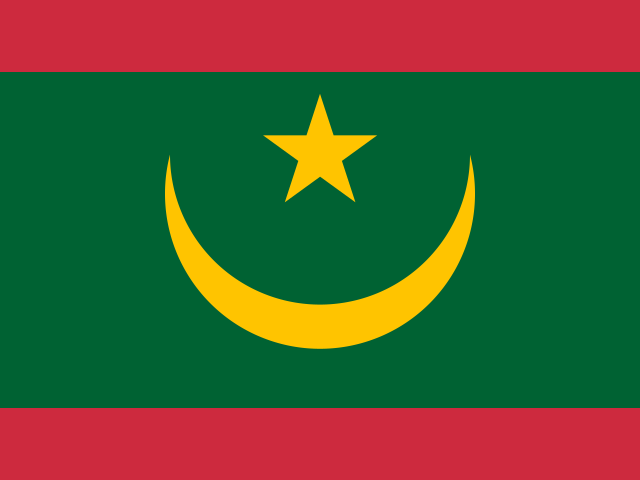
 Mauritania
Comprehensive education database information
Education System in Mauritania
Overview of Mauritania
The Islamic Republic of Mauritania is situated on the northwest coast of Africa, bordered by the Western Sahara, Algeria, Mali, Senegal, and the North Atlantic Ocean. With a population of approximately 3.36 million, the country has a literacy rate of 51.2%. Arabic serves as the official language, while Pulaar, Soninke, and Wolof are recognized as national languages. French is also widely used, particularly among the educated populace. Historically, Mauritania has been shaped by the interactions and conflicts between its original inhabitants, the Bafours, and later Berber and Arab settlers. After becoming a French colony in 1904 and part of French West Africa by 1920, Mauritania gained independence in 1960. Despite free and compulsory education for children aged 6 to 14, actual attendance remains a challenge, with many completing only five years of schooling.
Introduction to the Education System
Mauritania's education system has undergone significant changes, particularly after a 1999 reform that streamlined the educational structure by adopting a single language of instruction. Currently, education begins in Arabic, with French introduced as a foreign language in the second year of primary school. The structure is divided into several levels: primary, secondary, and tertiary education, each with distinct curriculums and qualifications.
Education Levels
Primary Education
- Pre-Primary Level: Children aged 4 to 6 attend Koranic schools where they focus on memorizing verses from the Koran.
- Formal Education: At age 6, students enter a compulsory and free formal education system. However, many families, especially in rural areas, face financial barriers that hinder access to educational resources and feeding programs.
- Duration: The primary education cycle lasts for 6 years (ages 6 to 12). At the conclusion, pupils must pass an examination to receive the Certificat d'Études Primaires Élémentaires (CEPE).
Middle Education
- The first 4 years of secondary education occur at collèges, where students engage in a general academic curriculum.
- To progress to the Lycée, students must achieve a satisfactory report or obtain the Brevet d'Études du Premier Cycle diploma.
Secondary Education
- The final 3 years of the education system are spent at Lycées. Students can select from various academic tracks, including:
- Arabic & Islam
- Modern Languages
- Natural Sciences
- Mathematics
- Upon completion, students sit for a national examination leading to the baccalauréat, crucial for university admission.
Vocational Education
- Recognizing the importance of technical and vocational training, the Mauritanian government is actively working to bolster this sector to support the country's developing industrial economy.
- Various initiatives are underway to improve vocational education, with funding partly sourced from international loans.
Tertiary Education
- Lower tertiary institutions include:
- National School of Administration
- National Teachers School
- National School of Public Health
- The University of Nouakchott, established in 1981, is the only university in the country and consists of three faculties:
- Arts & Social Sciences
- Economy & Law
- Technical Sciences
- After completing 2 years of study, students receive a Diplôme du Premier Cycle d'Études Universitaires. An additional 2 years is required to obtain a Maîtrise degree.
Teacher Training
- Primary School Teachers: Training is conducted at an École normale d'Instituteurs (ENI), where a 2-year program culminates in a Certificat d'Aptitude Pédagogique. Admission requires a Brevet d'Études du Premier Cycle (BEPC).
- Lower Secondary School Teachers: These educators are trained for 1 year at the école normale supérieure (ENS), earning a Certificat d'Aptitude aux Fonctions de Professeur du Premier Cycle (CAPPC). Admission requires a Diplôme du Baccalauréat de l'Enseignement du Secondaire.
- Upper Secondary School Teachers: Similar to lower secondary training, this 2-year program at the ENS leads to a Certificat d'Aptitude au Professorat de l'Enseignement Secondaire (CAPES). Admission requires a Diplôme d'Études Universitaires Générales (DEUG). Students holding a Maîtrise can complete this program in 1 year.
Conclusion
The education system in Mauritania reflects a blend of traditional and modern influences, with ongoing efforts to improve accessibility and quality across all levels of education. Despite challenges, the commitment to education is evident, as the nation strives to enhance opportunities for its youth and support the country's development.