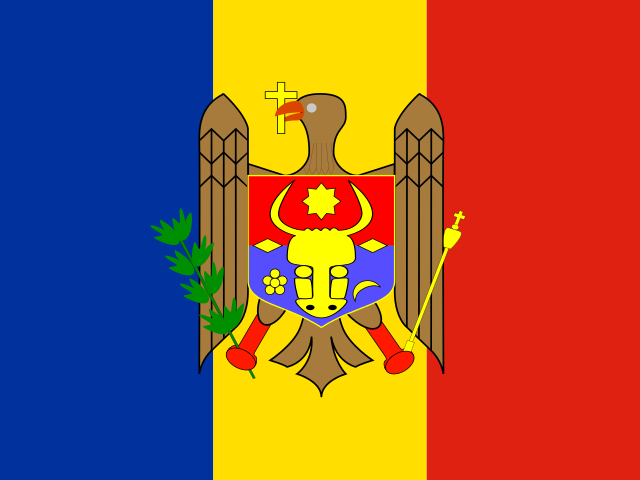
 Moldova
Comprehensive education database information
Education System in Moldova
Overview of Moldova
The Republic of Moldova is a landlocked nation located in Eastern Europe, bordered by Romania to the west and Ukraine to the north, east, and south. With a population of approximately 4.3 million people, the country exhibits a rich cultural tapestry, where about 75.8% of the inhabitants identify as ethnic Moldovans, while the rest include Ukrainians, Russians, Gagauz, Romanians, and Bulgarians. The official language is Moldovan, which is linguistically similar to Romanian, alongside other prevalent languages such as Russian and Gagauz, a dialect of Turkish. Moldova boasts an impressive literacy rate of 99.1%. Historically, the territory has seen various governance changes, having been part of the Principality of Moldavia, the Russian Empire, and the Soviet Union before gaining independence on August 27, 1991.
Introduction to the Education System
Moldova's education system is designed to provide a structured and comprehensive framework for learners from early childhood through to tertiary education. The system emphasizes both academic and vocational training, catering to the diverse needs of its populace. Education is compulsory for children between the ages of 6 and 17 and is overseen by the Ministry of Education, Culture, and Research.
Education Levels
Primary Education
- Compulsory Education: In Moldova, education is mandatory for all children ages 6 to 17.
- Primary School: This initial stage, known as Școală Primară, begins at age 6 and lasts for four years, concluding typically by age 10. At this level, students do not receive a formal credential upon completion.
Lower Secondary Education
- Lower Secondary School: Following primary education, students advance to Învăţămîntul Gimnazial, which lasts for five years. This stage helps to further develop students' foundational skills and knowledge.
- Curriculum: The curriculum covers a range of academic subjects, assisting students in identifying their strengths and interests, which may influence their future career paths.
Secondary Education
- Academic Pathways: After lower secondary education, students can choose to pursue an academic pathway or a vocational alternative. Those continuing with academic education typically attend liceum for an additional three years.
- Diploma de Bacalaureat: Upon completion of secondary education, typically around age 18, students take an examination leading to the Diploma de Bacalaureat, which is a prerequisite for admission to tertiary education.
Vocational Education
-
Vocational Training Options: Students have the opportunity to enroll in vocational education programs after completing lower secondary education:
- Attend a technical upper secondary school for one to one and a half years, leading to either an Adeverinţă or a Certificat de Studii Secundare Professionale.
- Enroll in a vocational upper secondary school for four years, culminating in a Diploma de Bacalaureat with a professional qualification.
-
Access to Tertiary Education: Students who follow vocational tracks can still pursue higher education, even if they do not obtain the Diploma de Bacalaureat.
-
Improvement Initiatives: In December 2010, Moldova initiated a program aimed at enhancing vocational training, particularly in rural regions, to promote economic development.
Tertiary Education
- Types of Institutions:
- Colleges: These institutions offer higher technical and vocational training that typically lasts between two to three years, with some programs leading to undergraduate qualifications.
- Universities: Moldova is home to a variety of private and state universities, including the renowned Moldova State University, established in 1946. This university is notable for its 11 faculties and has contributed significantly to the nation's progress, with its standards continually improving.
This comprehensive education system in Moldova aims to equip students with the essential skills and knowledge needed to succeed in both local and global contexts, fostering a well-rounded and capable workforce.