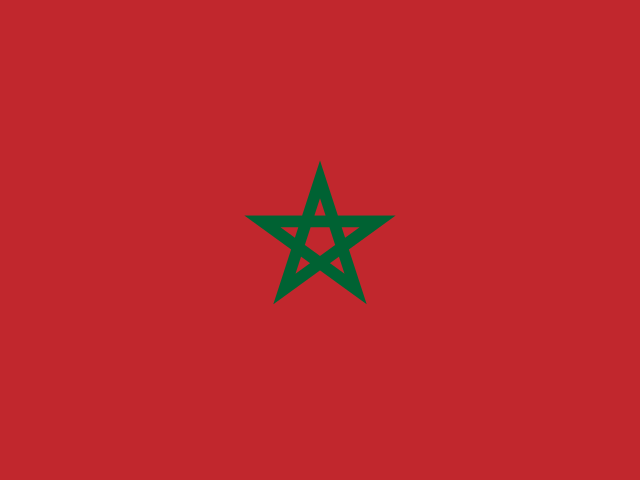
 Morocco
Comprehensive education database information
Education System in Morocco
Overview of Morocco
The Kingdom of Morocco, located in North Africa, boasts a rich cultural heritage and a diverse landscape that includes both coastal regions along the Atlantic Ocean and mountainous areas. With a population of approximately 33 million, Morocco is bordered by Algeria to the east, Spain to the north, and Mauritania to the south. Since gaining independence in 1956, Morocco has established itself as a constitutional monarchy and has engaged in various international partnerships, notably as a member of the Arab League. The country has a unique educational history shaped by both pre-colonial Islamic traditions and the French colonial system.
Introduction to the Education System
Morocco's education system has undergone significant reforms since independence, aimed at improving accessibility and quality. The Royal Commission for Education Reform set forth a vision to Arabize the curriculum and expand educational opportunities across different social strata. Despite these efforts, challenges persist, particularly in rural areas where school attendance is lower. The education system is structured into several levels, encompassing Primary, Middle, Secondary, Vocational, and Tertiary Education.
Primary Education
Key Features
- Duration: The primary education program spans 6 years.
- Compulsory Age: Education is mandatory until the age of 15.
Challenges
- There are significant barriers to school attendance, particularly for girls in rural regions.
- A substantial dropout rate exists, with approximately 21% of students leaving before completing their primary education.
- Literacy rates remain low, attributed to these dropout trends and lack of access.
Middle Education
Overview
- Duration: Middle education consists of a 3-year program offered at middle schools.
- Completion Rate: Fewer than 60% of students successfully complete this educational stage.
Economic Influences
- In economically disadvantaged areas, many children leave school early to contribute to their family’s income through work, further impacting educational attainment.
Secondary Education
Curriculum Structure
- The first year of secondary education includes a core curriculum that covers:
- Arts & Science
- Mathematics
- Original Education (reflecting the traditional Koranic system)
Specialization Opportunities
In the final two years, students can choose to specialize in various fields, including:
- Agricultural Science
- Earth & Life Sciences
- Mathematics
- Physics
- Technical Studies
Vocational Education
Purpose and Goals
Morocco is actively working to reduce unemployment through vocational training initiatives.
Initiatives
- Plans are underway to increase institutional capacity for vocational training.
- The government aims to establish partnerships with the business sector to enhance job readiness.
Aspirations
By 2013, the goal was to train approximately 750,000 new workers to align with market needs and reduce unemployment rates.
Tertiary Education
Institutions Overview
Morocco is home to 14 universities, which provide a range of academic programs.
Notable Universities
-
Mohammed V University in Rabat is recognized as the foremost institution, offering faculties in:
- Law
- Liberal Arts
- Medicine
- Sciences
-
University of Al-Karaouine (or Al-Qarawiyyin), established in 859, is revered as the oldest university in the world and continues to serve as a significant educational and spiritual hub within the Muslim World.
Conclusion
The education system in Morocco reflects the country's historical complexities and ongoing efforts to enhance educational access and quality. While significant strides have been made since independence, especially in terms of curriculum reform and increased enrollment, challenges remain, particularly in rural areas. Continuous efforts are necessary to ensure that all children, regardless of gender or location, have the opportunity to receive a quality education that prepares them for the future.