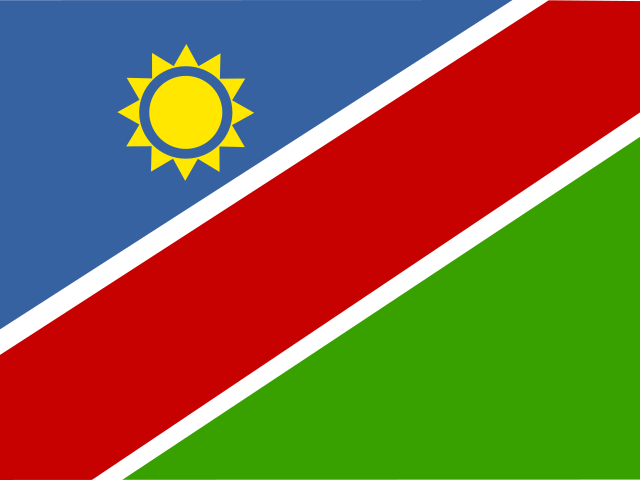
 Namibia
Comprehensive education database information
Education System in Namibia
Namibia is a southern African nation bordered by Angola, Zambia, Botswana, and South Africa. With a population of approximately 2.1 million, it boasts an impressive literacy rate of 85%. English serves as the official language; however, Afrikaans is widely spoken among the populace. Namibia's rich history includes early human habitation by the Bushmen and later settlements by Bantu tribes. European exploration began in the late 15th century, culminating in Namibia becoming a German colony in the 19th century. Following a tumultuous period of South African administration and a struggle for independence, Namibia finally gained its sovereignty on March 21, 1990.
Overview of the Education System
Since gaining independence, Namibia has made significant strides in developing an education system aimed at providing equal access to education for all its citizens. The Namibian education structure is segmented into several key stages: primary education, middle education, secondary education, vocational education, and tertiary education.
Primary Education
- Duration: Primary education spans 7 years, commencing at age 6.
- Progression: Students advance through grades based on their academic competencies rather than age.
- Pre-Primary Education: A pre-primary program is in place, aimed at enhancing early childhood education, with a goal of widespread implementation.
Middle Education
- Middle education is categorized into two distinct phases:
- The first phase lasts for 3 years, culminating in the Junior Secondary School Certificate Examination.
- Post-completion, students have the option to either:
- Pursue an academic curriculum for further education.
- Enter the workforce directly, focusing on practical career skills.
Secondary Education
- The secondary education segment consists of an additional 2 years, which is optional and incurs tuition fees.
- This level of education is primarily offered in urban areas.
- To gain admission to universities, students must successfully complete either:
- The International General Certificate of Education (IGCSE), overseen by Cambridge University.
- The Higher International General Certificate of Education (HIGCSE), also administered by Cambridge.
Vocational Education
- The Namibian government is actively revitalizing its vocational training centers to better serve the needs of trade and industry.
- This initiative includes the establishment of various unit standards designed to ensure the development of skilled, job-ready individuals.
Tertiary Education
- Namibia's tertiary education landscape is anchored by two main institutions:
- The Polytechnic of Namibia
- The University of Namibia, which was founded in 1992 in Windhoek.
- Admission requirements vary between institutions, with the Polytechnic accepting students who have achieved a Grade 12 Certificate, while the University maintains more stringent criteria.
- The University of Namibia offers programs across multiple faculties, including:
- Agriculture & Natural Sciences
- Economics & Management Science
- Education
- Humanities & Social Sciences
- Law
- Medical & Health Sciences
- Engineering & Information Technology
In summary, the education system in Namibia has been progressively evolving to provide equitable opportunities for all learners. From primary to tertiary levels, the focus remains on enhancing educational access and quality, ensuring that students are well-prepared for future challenges in both the workforce and higher education.