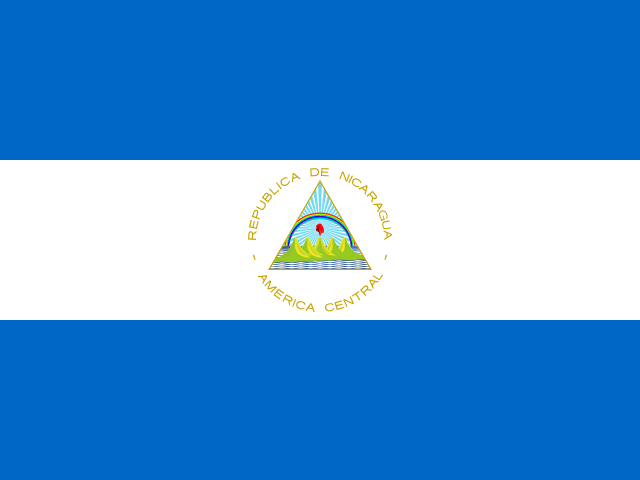
 Nicaragua
Comprehensive education database information
Education System in Nicaragua
Overview of Nicaragua
Nicaragua, officially known as the República de Nicaragua, is the largest country in Central America, bordered by Honduras to the north, Costa Rica to the south, the Pacific Ocean to the west, and the Caribbean Sea to the east. The nation has a population of approximately 5.8 million people, with a literacy rate of around 67.5%. The predominant language spoken is Spanish, used by nearly 98% of the population. The demographic composition includes 69% Mestizo, 17% White, 9% Black, and a small percentage of Amerindian individuals. The history of civilization in Nicaragua dates back over 6,000 years, with significant European contact initiated by Christopher Columbus in 1502. Nicaragua gained independence in 1821 and became a republic in 1838.
Introduction to the Education System
Nicaragua's education system is managed by the Ministerio de Educación and encompasses various levels of education. Education is free and mandatory for children ages 6 to 12. The system aims to improve literacy and educational access, but it faces significant challenges, particularly in rural areas and among impoverished communities.
Primary Education
Key Features
- Duration: Primary education lasts for six years.
- School Year: The academic year operates from February to November.
- Access: While education is free and compulsory, access is limited in remote regions, where many children are required to assist their families with work.
- Completion Rates: Only about 30% of enrolled students successfully complete sixth grade.
- Dropout Concerns: High dropout rates are attributed to insufficient facilities for continued education and a lack of governmental support.
Upon completing primary education, students receive a Diploma de Educación Primaria.
Secondary Education
Overview
Secondary education in Nicaragua is divided into two main streams: lower secondary and upper secondary.
- Lower Secondary: This stage lasts for three years, leading to a Diploma de Curso Básico.
- Upper Secondary: Students may choose between academic or vocational tracks.
- Vocational Upper Secondary: Typically lasts three years and awards a Técnico Medio diploma.
- Academic Upper Secondary: This program is approximately two years long and culminates in a Bachiller en Ciencias y Letras.
Challenges
- Perception of Education: Secondary education is often viewed as a luxury that is unaffordable for many, particularly among poorer populations.
- Division: The education system exhibits significant disparities along ethnic and linguistic lines, with access to quality education often reserved for wealthier individuals.
- University Preparation: Students who complete upper secondary education may qualify for university admission; however, concerns about the quality of their education persist.
Vocational Education
Structure and Offerings
Vocational education in Nicaragua mainly takes place in private institutions located in urban areas. Key aspects include:
- Program Duration: Vocational courses typically span two to three years.
- Employment Outlook: Graduates often find themselves in low-paying jobs, especially in rural regions where opportunities are limited.
- Qualifications: The primary qualification awarded in vocational education is the Técnico Superior diploma.
Tertiary Education
Entry Requirements and Structure
Tertiary education in Nicaragua encompasses various paths:
- Admission Criteria: To enroll in a university, students must possess a secondary school diploma, pass an entrance examination, and pay tuition fees.
- Undergraduate Degrees: The main undergraduate qualification is the Licenciatura, which requires four to five years of study and may confer a professional title.
- Graduate Programs: Students can pursue further studies through a two-year Maestría program, which involves coursework and thesis defense.
The oldest higher education institution in the country is the Universidad Nacional Autónoma de Nicaragua, established in 1812 during the colonial era.
In summary, while Nicaragua's education system has made strides toward inclusivity and accessibility, significant challenges remain, particularly in rural areas and for economically disadvantaged populations. The path from primary to tertiary education is structured but fraught with obstacles that impact student retention and overall educational quality.