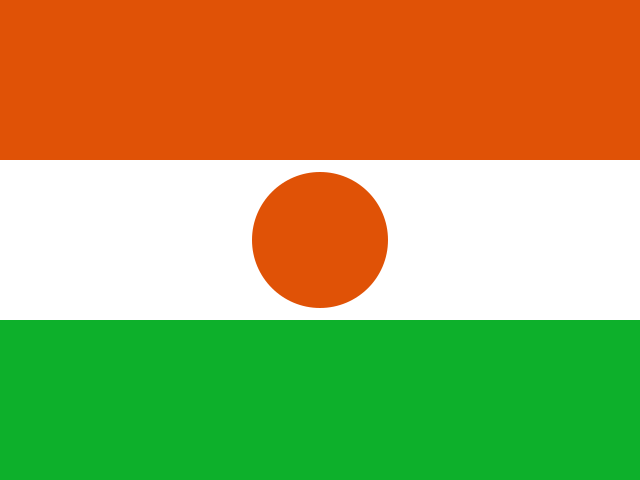
 Niger
Niger
Comprehensive education database information
Education System in Niger
Overview of Niger
The République du Niger is situated in West Africa and is a landlocked nation bordered by several countries, including Algeria, Libya, Chad, Nigeria, Benin, Burkina Faso, and Mali. With a population of approximately 13.3 million, Niger is recognized as one of the least developed and economically challenged countries globally. The country's landscape is dominated by the Sahara Desert, which covers around 80% of its territory, contributing to its status as one of the hottest regions in the world. The literacy rate in Niger stands at a low 28.7%. French serves as the official language, while indigenous languages such as Hausa and Djerma are commonly spoken. The area has a rich history, with evidence of human civilization dating back to 10,000 BC. The Tuareg and Hausa tribes settled in the region during the 17th and 18th centuries, and Niger gained independence from French colonial rule on August 3, 1960.
Introduction to the Education System
Niger's education system is characterized by its commitment to providing free and compulsory education for children aged 6 to 12 years, although the average duration of schooling is just four years. The system faces numerous challenges, including cultural and gender disparities, which hinder equal access to education. Efforts to improve educational access and quality are ongoing, despite the obstacles posed by limited resources and infrastructural inadequacies.
Levels of Education
Primary Education
- Duration: Primary education lasts for 6 years, starting at age 6.
- Compulsory Education: This level is mandatory for all children.
- Completion Rates: There is a significant gender gap in completion rates, with a higher number of boys finishing primary school compared to girls.
- Facility Limitations: Many primary education facilities are constrained, particularly in rural regions, making access difficult for some children.
Lower Secondary Education
- Duration: Following primary education, students who continue their education attend lower secondary school for 4 years.
- Curriculum: The curriculum aligns with the French educational framework, focusing on a broad academic foundation.
- Access Issues: Access to lower secondary education is often limited, particularly in rural areas, and is largely unavailable to nomadic tribes.
Upper Secondary Education
- Duration: Upper secondary education encompasses an additional 3 years after lower secondary school.
- Specialization Options: Students can choose to specialize in academic subjects or pursue technical education.
- Certification: Upon completion, students receive:
- Diplôme de Bachelier de l'Enseignement du Second Degré for academic tracks.
- Diplôme de Bachelier Technicien for technical tracks.
Tertiary Education
- Types of Programs: Tertiary education includes both academic and vocational training, as well as specialized programs such as teacher training.
- Universities: Niger has two primary universities:
- Abdou Moumouni University of Niamey, established in 1973, is a state-run public institution.
- Islamic University of West Africa, founded in 1987.
- Faculties at Abdou Moumouni University:
- College of Agronomy
- College of Arts and Human Sciences
- College of Natural Science
Teacher Training
- Primary Education: Primary school teachers undergo a 3-year training program at specialized institutions, culminating in the Diplôme de Fin d'Études Normales (DFEN).
- Lower Secondary Education: Teachers for lower secondary schools complete a one-year program requiring prior educational qualifications, leading to the Diplôme d'Aptitude Professionnelle au Professorat des Collèges d'Enseignement Général (DAP/CEG).
- Upper Secondary Education: Upper secondary teachers complete a one-year training program after obtaining a Maîtrise, receiving the Certificat d'Aptitude Professionnelle à l'Enseignement Secondaire (CAPES) upon graduation.
Conclusion
The education system in Niger, while legally structured to provide access to education for all children, encounters considerable challenges. Issues such as gender inequality, limited educational facilities, and access disparities continue to impede the overall effectiveness of the system. Nevertheless, ongoing efforts to improve educational quality and equity are essential for the nation's development and the empowerment of its youth.