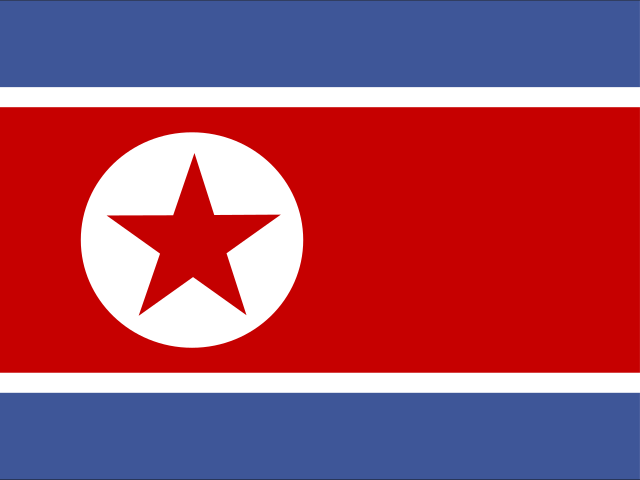
 North Korea
Comprehensive education database information
Education System in North Korea
Overview of North Korea
North Korea, officially known as the Democratic People's Republic of Korea (DPRK), is a country located in East Asia, occupying the northern part of the Korean Peninsula. It is bordered by China to the north and Russia to the northeast, with the Yellow Sea to the west and the Sea of Japan to the east. The capital city is Pyongyang, which serves as the political, economic, and cultural center of the nation. The country is known for its strict government control and isolation from much of the international community, leading to a unique socio-political landscape.
Introduction to the Education System
The education system in North Korea is heavily influenced by the state and is designed to align with the country's ideological framework. Education is regarded as a fundamental right and is provided free of charge at all levels. The government emphasizes the importance of education as a means to cultivate loyalty to the state and its leaders. The system aims to instill a strong sense of nationalism and socialist values among students, alongside academic knowledge.
Structure of the Education System
The education system in North Korea is divided into several key levels, each designed to cater to the developmental needs of students at different ages.
1. Pre-Primary Education
- Age Group: 3 to 5 years
- Duration: 2 years
Pre-primary education in North Korea is not universally available, but it serves as an introduction to formal education. It focuses on basic social skills, early literacy, and physical development through play-based learning. The curriculum is designed to prepare children for primary school.
2. Primary Education
- Age Group: 6 to 11 years
- Duration: 5 years
Primary education is compulsory and free for all children. The curriculum typically includes subjects such as:
- Korean Language and Literature
- Mathematics
- Natural Sciences
- Social Studies
- Physical Education
In addition to academic subjects, there is a strong emphasis on political education, which aims to instill socialist values and loyalty to the ruling party.
3. Secondary Education
- Age Group: 12 to 16 years
- Duration: 6 years
Secondary education is divided into two stages: lower secondary (first three years) and upper secondary (last three years).
Lower Secondary Education
- Focuses on expanding knowledge in core subjects while introducing additional topics like foreign languages and technical skills.
- Subjects include:
- Advanced Mathematics
- Physics
- Chemistry
- History
- Ideological Education
Upper Secondary Education
- Prepares students for higher education or vocational training.
- Students may choose specialized tracks that align with their career aspirations, such as science, arts, or technical fields.
4. Higher Education
- Age Group: 17 years and above
- Duration: Typically 4 to 6 years
Higher education institutions include universities, colleges, and technical schools. Admission is competitive and often based on academic performance and political reliability. Students can pursue degrees in various fields, including:
- Engineering
- Medicine
- Education
- Arts and Humanities
The curriculum at this level is rigorous and includes a strong emphasis on ideological education to ensure alignment with state principles.
Conclusion
The education system in North Korea is characterized by its state control and emphasis on ideological conformity. While it provides free education to its citizens from pre-primary through higher education, the curriculum is heavily infused with political content aimed at fostering loyalty to the regime. This structure reflects the broader socio-political environment of the country and underscores the role of education in shaping the future of North Korean society.