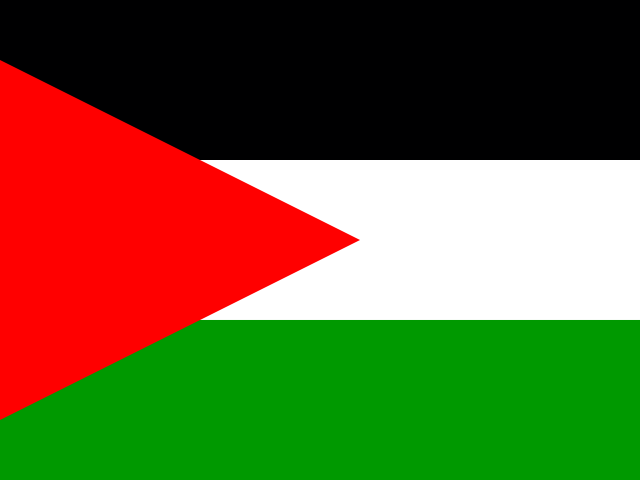
 Palestine
Comprehensive education database information
Education System in Palestine
Palestine, a region located in the Middle East, is divided into two main territories: the Gaza Strip and the West Bank. The Gaza Strip lies along the Mediterranean Sea and is bordered by Egypt to the south and Israel to the north and east. The West Bank shares a border with Jordan to the east and is surrounded by Israel on the north, south, and west sides. The educational landscape in Palestine has been shaped by a complex history of colonial influences, conflicts, and administrative changes, which have hindered the establishment of a fully autonomous education system. Before 1994, the West Bank adhered to the Jordanian education model, while the Gaza Strip followed the Egyptian system. The signing of the Oslo Accords in 1994 paved the way for the unification of the two systems under the newly established Ministry of Education and Higher Education (MEHE), which aimed to create a distinct Palestinian National Curriculum.
Overview of the Education System
The education system in Palestine is designed to facilitate learning across various stages, from early childhood education to higher education. The Ministry of Education and Higher Education plays a crucial role in overseeing the educational process, ensuring coordination and quality across all levels. The system is characterized by distinct phases, each with specific goals and requirements tailored to the needs of Palestinian students.
Preprimary Education
- Preprimary education lasts for two years, catering to children aged 4 to 6.
- This stage is neither free nor compulsory and serves as an introduction to formal education.
Basic Education
- Basic education is compulsory and begins at age 6, spanning Grades 1 to 10.
- Students in this phase acquire foundational knowledge and skills essential for their academic journey.
- Schools operated by the United Nations Relief and Works Agency (UNRWA) also provide education from Grades 1 to 10.
Secondary Education
- Secondary education consists of two final years, covering Grades 11 and 12.
- Attendance in this stage is not compulsory, allowing students to choose between academic and vocational tracks.
- The academic track includes disciplines in Science and Humanities, while the vocational track encompasses fields such as agriculture, commerce, home economics, hotel management, and industrial studies.
- Successful completion of Grade 10 is a prerequisite for entering Grade 11.
- Students who finish Grade 12 must take the Tawjihi, a national examination that determines eligibility for higher education.
Vocational Education
-
Palestine hosts over 15 secondary industrial schools dedicated to providing technical education across various domains:
- Agriculture
- Commerce
- Hotel Management
- Home Economics
- Industrial Studies
-
Despite the availability of vocational programs, participation rates are relatively low.
-
There are also several rehabilitation centers aimed at assisting students who have left the formal education system.
Tertiary Education
Tertiary education in Palestine encompasses a wide array of post-secondary institutions, including:
- Colleges that offer two-year diploma programs
- Universities that provide four-year undergraduate degrees and higher
Among these institutions, Al-Azhar University, established in Gaza in 1994, is the oldest and serves as a significant educational hub. It offers diverse faculties, including:
- Pharmacy
- Arts
- Mediterranean Studies
- Law
- Education
- Agriculture
- Water Sciences & Environment
- Statistics
- Accounting
- Business Administration
- Economics
- Political Science
- Chemistry
- Biology
- Mathematics
Currently, Al-Azhar University accommodates over 10,000 students, making a substantial contribution to the higher education sector in Palestine.
Postgraduate Education
The postgraduate sector in Palestine consists of various programs structured as follows:
-
First Cycle: Admission to undergraduate programs requires the Certificate of General Secondary Education. Programs can range from two years for an Associate Diploma to four years for a Bachelor's degree. Specialized programs in fields like law and engineering may require longer durations.
-
Second Cycle: Graduate programs, which typically require a bachelor’s degree for admission, include one-year Higher Diplomas and research-based master’s degrees.
-
Third Cycle: Doctoral programs represent the highest level of education, requiring extensive coursework and the completion of a major thesis. A minimum of three years of study is generally needed to earn a Ph.D..
Credit System
Palestinian colleges and universities follow a semester unit credit system with the following credit requirements:
- Associate Diploma: 66 semester units
- Bachelor of Arts/Science: 120 semester units
- Higher Diploma: 30 semester units
- Master's Degree: 36 semester units
- Ph.D.: 48 semester units
In summary, the education system in Palestine is a multifaceted framework that aims to equip students with the necessary skills and knowledge for their future. Despite the challenges posed by historical and contemporary issues, the MEHE continues to strive for improvement and development within the educational landscape of Palestine.