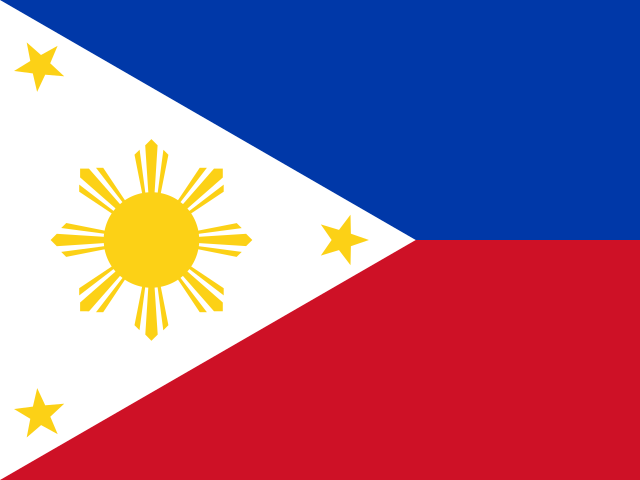
 Philippines
Comprehensive education database information
Education System in the Philippines
The Philippines is an archipelago located in Southeast Asia, consisting of over 7,000 islands. It has a rich cultural heritage influenced by various colonizers, notably Spain and the United States. This diverse history has shaped the country's social, political, and educational landscape. The education system in the Philippines reflects a blend of traditional values and modern practices, with an emphasis on both academic achievement and character development.
Overview of the Education System
The educational framework in the Philippines is designed to foster comprehensive academic growth through several distinct levels: Primary Education, Secondary Education, Vocational Education, and Tertiary Education. Each stage plays a vital role in equipping students with essential knowledge and skills for their future endeavors.
Primary Education
Structure and Duration
Primary Education, known locally as Paaralang Elementarya, constitutes the first six years of compulsory schooling, covering Grade 1 to Grade 6. Some institutions may offer an optional 7th grade, allowing students additional time to solidify their foundational skills.
Curriculum
The primary curriculum includes a range of subjects aimed at providing a well-rounded education:
-
Core Subjects:
- Mathematics
- Science
- English
- Filipino
- Social Studies
-
Optional Subjects:
- Music
- Arts
- Physical Education
- Health
In private institutions, students often have the opportunity to select from a wider array of subjects, including religious studies based on personal belief systems.
Assessment
Until 2004, students were required to take the National Elementary Achievement Test (NEAT), which was administered by the Department of Education, Culture, and Sports (DECS). Following the rebranding of DECS to the Department of Education (DepEd), the NEAT was replaced by the National Achievement Test (NAT). This assessment evaluates the competency of students from both public and private elementary schools. Since 2006, only private schools have mandated entrance exams for secondary education.
Secondary Education
Structure and Duration
Secondary Education, referred to as Paaralang Sekundarya, consists of four years of schooling and has maintained a consistent structure since World War II. The curriculum is standardized across public and private schools.
Curriculum
The subjects covered in secondary education are divided across four years:
-
Year 1:
- Filipino 1
- Algebra 1
- Integrated Science
- English 1
- Philippine History
-
Year 2:
- Filipino 2
- Algebra 2
- Biology
- English 2
- Asian History
-
Year 3:
- Filipino 3
- Geometry
- Chemistry
- World History
- Geography
-
Year 4:
- Filipino 4
- Calculus
- Trigonometry
- Physics
- Literature
- Economics
Optional Subjects
In addition to core subjects, students may choose from minor subjects such as:
- Health
- Music
- Arts
- Physical Education
- Home Economics
- Technology
The total enrollment in secondary schools exceeds 5.5 million students.
Vocational Education
Vocational education in the Philippines is primarily provided by accredited private institutions known as vocational colleges. These colleges offer technical and vocational training programs that can last from a few weeks to up to two years, resulting in diplomas.
Admission Requirements
- Most vocational colleges do not require entrance examinations.
- Admission is generally based on the applicant's high school education record and the payment of an enrollment fee.
Upon completing their programs, students may take nationally administered examinations to earn their diplomas or certificates.
Tertiary Education
Institutional Framework
The Commission on Higher Education oversees most higher education institutions in the Philippines.
Types of Institutions
- Colleges: These institutions often provide specialized programs.
- Universities: To qualify as a university, an institution must offer at least eight undergraduate programs in various fields and at least two graduate programs.
Public Universities
Public universities in the Philippines are non-sectarian and provide a wide array of academic programs, with English serving as the primary medium of instruction. These institutions are funded by the government, with the University of the Philippines receiving a significant portion of the national budget.
Private Institutions
Numerous private tertiary institutions exist, both sectarian and non-sectarian, and may operate on a for-profit or non-profit basis. Many of these institutions are affiliated with Catholic organizations.
Degree Programs
Most universities offer four-year degree programs, typically structured into two semesters each academic year.
Conclusion
The education system in the Philippines has evolved significantly since its inception, incorporating elements from both colonial influences and modern educational practices. With a focus on foundational knowledge, vocational training, and higher education, the system aims to prepare students for both local and global challenges, ensuring that they develop the skills necessary for success in an increasingly interconnected world.