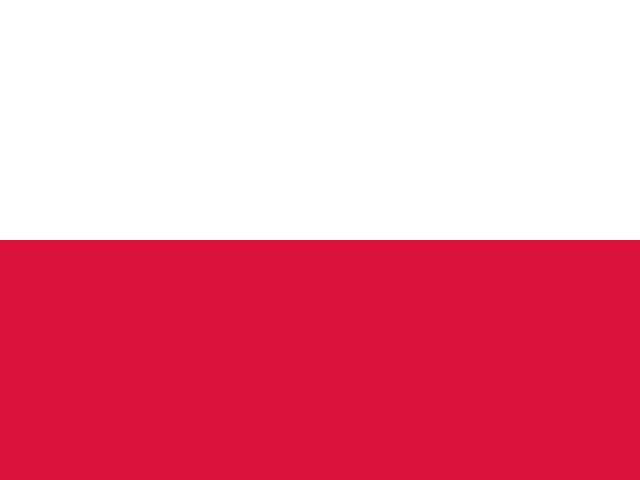
 Poland
Comprehensive education database information
Education System in Poland
Poland, located in Central Europe, is bordered by the Baltic Sea to the north. The country has a rich and complex history marked by shifts in territory and cultural diversity. Over the years, Poland has developed a strong national identity, though significant events like World War II have profoundly influenced its demographics and societal structures. The transition to a market economy in the 1990s created a heightened demand for skilled professionals, prompting reforms in various sectors, including education.
Overview of the Education System
Poland's education system is designed to equip students with the necessary skills and knowledge for their future endeavors. It is organized into several key stages: Primary Education, Secondary Education, Vocational Education, and Tertiary Education. Each stage is integral to the holistic development of students, ensuring they are prepared for both academic and professional challenges.
Primary Education
Compulsory Preschool Education
- One year of preschool education is mandatory, aimed at developing foundational skills in reading and mathematics.
Primary School
- Age Range: Students typically attend primary school from ages 7 to 12.
- Structure:
- First Cycle (Grades 1-3): This phase emphasizes introductory learning with a single teacher guiding the students.
- Second Cycle (Grades 4-6): Focuses on more systematic educational approaches and subject specialization.
Subjects Offered
Primary education encompasses a variety of subjects designed to foster a well-rounded education:
- Art and Music
- Crafts and Technology
- Polish Language
- Mathematics
- Social and Natural Environment
- Physical Education
Cost
Both primary and secondary education in Poland are provided free of charge, ensuring accessibility for all students.
Secondary Education
Streams
Secondary education in Poland is divided into two main streams:
- General Schools: These are geared towards students preparing for university education, offering a curriculum that aligns with higher education requirements.
- Vocational Schools: These institutions focus on equipping students with practical skills for the workforce while also providing a general education.
Vocational Education
Students enrolled in vocational education have opportunities to further their studies at post-secondary institutions. Fields of training available in vocational education include:
- Accountancy
- Administration
- Computer Specializations
- Nursing
- Librarianship
Tertiary Education
Institutions
Poland's tertiary education landscape is diverse and includes various types of institutions:
- Universities
- Economic and Agricultural Academies
- Polytechnics
Academic Center
Warsaw serves as the central hub for higher education in Poland, drawing a significant number of academics and students due to its comprehensive educational offerings.
Historical Context
Poland has a long-standing tradition of higher education, beginning with the establishment of the Academy of Kraków in 1364, which is the oldest university in the country. Over the centuries, additional universities have been founded, enriching the academic landscape.
Specialized Institutions
Aside from general universities, Poland is home to numerous specialized institutions, including:
- Technical universities
- Medical universities
- Agricultural academies
- Colleges focusing on various disciplines such as teaching, music, theology, economics, and maritime studies.
The education system in Poland reflects the country's commitment to providing quality education across all levels. With its structured approach, students are not only prepared for academic pursuits but also equipped with essential skills for their future careers.