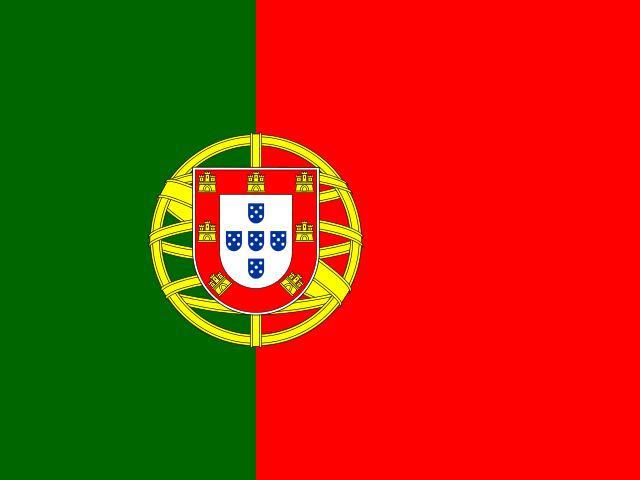
 Portugal
Comprehensive education database information
Education System in Portugal
Overview of Portugal
Portugal, officially known as the Portuguese Republic, is situated on the western edge of Europe. It shares a border with Spain to the east and is flanked by the North Atlantic Ocean to the north, west, and south. The country also encompasses the autonomous regions of the Azores and Madeira. With a population of approximately 10.7 million and a literacy rate of 93.3%, Portuguese serves as both the official language and the primary language of instruction in educational settings.
Historically, Portugal has a rich cultural heritage and was influenced by various civilizations, including the Celts, Romans, and Moors. It gained independence from Spain in 1149 and embarked on an era of exploration during the 15th century, establishing colonies and trade routes across the globe. In modern times, Portugal became a founding member of NATO and joined the European Union in 1986.
Introduction to the Education System
The education system in Portugal is characterized by its structured approach, with compulsory education spanning from ages 6 to 18. It encompasses several educational stages, including primary, middle, secondary, vocational, and tertiary education. The system aims to provide a comprehensive educational experience, preparing students for both academic pursuits and vocational training.
Primary Education
Structure of Primary Education
Primary education, known as Ensino Básico, is compulsory for children starting at the age of 6. This phase is divided into three cycles:
- 1st Cycle:
- Duration: 4 years (Grades 1 to 4)
- Focus: A wide range of subjects, including personal and social education.
Upon completing the 1st Cycle, students advance to the 2nd Cycle, which consists of:
- 2nd Cycle:
- Duration: 2 years (Grades 5 and 6)
- Content: More advanced subjects to prepare students for middle education.
Middle Education
Middle education, referred to as Ensino Básico – 3º Ciclo, encompasses the 7th and 8th grades. The curriculum during this period includes:
- Core Subjects:
- Portuguese Language
- Two Foreign Languages
- Mathematics
- Natural Sciences
- Physics
- Chemistry
- Social Sciences
- Art (elective)
Additionally, students receive instruction in physical, moral, and civic education, along with introductory technical orientation to help identify vocational interests.
Secondary Education
Upon reaching 9th grade, students transition into secondary education, which offers two distinct pathways:
-
Academic Program:
- Focuses on theoretical knowledge across various disciplines.
-
Practical Program:
- Concentrates on practical skills in areas such as multimedia, electronics, and computing.
Both pathways include core subjects such as:
- Portuguese
- Philosophy
- Physical Education
- Foreign Languages
- Moral/Religious Education
The remainder of the curriculum is tailored to align with students' career aspirations and interests.
Vocational Education
In Portugal, initial vocational training provides an alternative path within secondary education. After completing middle school, students can pursue:
- Duration: Three-year vocational certificate programs.
- Focus: Development of practical skills in technical and artistic fields.
Moreover, numerous vocational colleges offer various training opportunities, both short-term and long-term, outside the traditional education framework.
Tertiary Education
Higher education in Portugal is delivered through both polytechnic and university institutions:
- Polytechnics: Emphasize practical training and skill development.
- Universities: Focus on academic education and research.
Despite the presence of many esteemed institutions, there have been concerns regarding the declining standards in higher education, which have sparked protests from both students and faculty members.
Portugal boasts several prestigious academic establishments, with roots dating back to the 13th century when the first medieval universities were founded. The Universidade de Coimbra holds the distinction of being the oldest university in continuous operation in the country.
Conclusion
The Portuguese education system is designed to equip students with a solid foundation across various levels, from primary to tertiary education. With a focus on both academic and vocational training, it aims to foster a knowledgeable and skilled workforce ready to meet the challenges of the modern world.