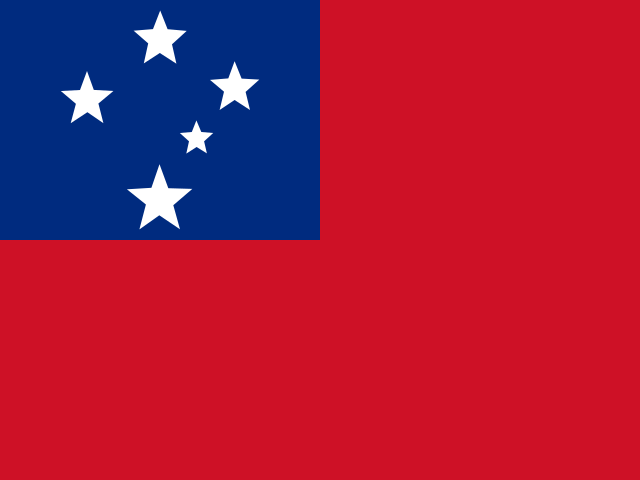
 Samoa
Samoa
Comprehensive education database information
Education System in Samoa
Overview of Samoa
The Independent State of Samoa is a picturesque archipelago situated in the South Pacific Ocean, roughly equidistant from Hawaii and New Zealand. With a population of approximately 217,083 inhabitants, Samoa boasts an impressive literacy rate of 99.7%. The two official languages spoken in the country are Samoan and English. Education in Samoa is mandatory for children aged 5 to 14, ensuring that the majority of the population has access to basic education. Local school districts play a crucial role in financing schools within their respective communities through levied fees.
Introduction to the Education System
Samoa's educational framework encompasses a structured progression through primary, secondary, and tertiary education. The system is designed to cater to the diverse needs of its students while maintaining a high standard of education. The country's education system operates under the collaborative efforts of the state and various religious missions, all adhering to a unified syllabus. This cooperation ensures that all students receive a coherent and comprehensive education.
Primary Education
Overview
- Primary education in Samoa spans eight years, beginning at age 5 and inclusive of one year of kindergarten.
- The literacy rate among primary school students is estimated to be around 97%.
- Education is primarily delivered by the state alongside five religious missions, which collectively adhere to a common curriculum.
Structure
- The initial four years of primary education take place in village schools.
- Following this foundational phase, gifted students are given the opportunity to transfer to district schools. In these institutions, the medium of instruction is predominantly English.
- In the capital city, Apia, urban schools manage the entire primary education process, offering a more centralized approach to learning.
Secondary Education
Overview
- Secondary education in Samoa is governed by the Samoan government, ensuring a uniform standard across all schools.
- The medium of instruction remains English, aligning with the language used in primary education.
Accessibility
- Secondary schools are primarily located in larger settlement areas, which can pose challenges for students residing in remote regions where educational opportunities may be limited.
- Students complete three years of junior secondary education, culminating in the awarding of a Year 11 Certificate.
Tertiary Education
Institutions
Samoa is home to several notable institutions of higher learning, including:
- College of Tropical Agriculture
- Trades Training College
- The flagship institution is the National University of Samoa, which was established in 1984.
Programs Offered
The National University of Samoa provides a wide array of academic programs, including:
- Certificate, diploma, and undergraduate degree programs
- Various forms of technical and vocational training
Faculties
The university is divided into several faculties, which include:
- Arts
- Business & Entrepreneurship
- Education
- Nursing & Health Science
- Science
- General Studies
- Engineering
- Maritime Training
The campus is uniquely designed to reflect a contemporary interpretation of a fale, the traditional Samoan beach hut, creating an inviting atmosphere for learning.
Teacher Training
To cultivate qualified educators, Samoa offers training programs for primary and secondary school teachers through a three-year program leading to a Diploma in Education or a Bachelor of Education at the National University of Samoa.
Conclusion
Samoa’s education system is a well-structured entity that aims to provide quality education to its youth. With a strong emphasis on collaboration between the state and religious missions, the country ensures that students receive an education that not only meets academic standards but also respects cultural values. This holistic approach fosters a knowledgeable and skilled populace ready to face the challenges of the modern world.