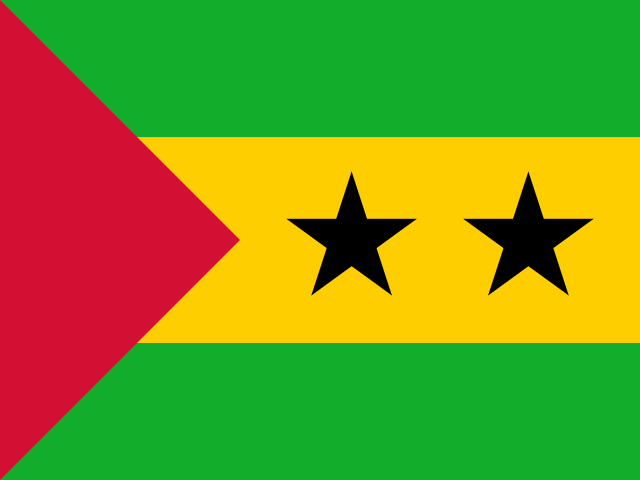
 Sao Tome and Principe
Comprehensive education database information
Education System in São Tomé and Príncipe
Overview of São Tomé and Príncipe
São Tomé and Príncipe is a small island nation located in the Gulf of Guinea, off the western coast of Central Africa. Comprising the islands of São Tomé, Príncipe, Pedras Tinhosas, Caroço, and Rôlas, it is the smallest country on the African continent, with a total area of approximately 1,001 square kilometers. The two main islands, São Tomé and Príncipe, are characterized by their mountainous terrain and are part of a series of extinct volcanoes.
The capital city is São Tomé. Historically, the islands were uninhabited until Portuguese navigators arrived in 1471, leading to their settlement by the end of the 15th century. Following the Portuguese Revolution in April 1974, the islands transitioned to independence, officially recognized on July 12, 1975. Today, São Tomé and Príncipe has a population of around 212,679, predominantly descendants of enslaved individuals brought from the African mainland. The literacy rate in the country stands at approximately 84.9%. The majority of the population resides on São Tomé Island, and Portuguese is the official language. The primary religious affiliations include Roman Catholicism and Evangelical Protestantism.
The Ministry of Education and Higher Education oversees all educational levels in the country, with Portuguese being the medium of instruction. The current educational reforms are guided by the Law of Educational Bases (LBSE), enacted in 2003.
Introduction to the Education System
The education system in São Tomé and Príncipe is structured to provide a comprehensive framework for learners from early childhood through higher education. It includes several levels, each designed to build on the previous stage, ensuring that students receive a robust education. The system is primarily divided into three main levels: primary education, secondary education, and post-secondary education.
Primary Education
Ensino Básico (Primary Education)
- Duration: 6 years (Grades 1 to 6)
- Age Requirement: Compulsory for children aged 6 to 11 years
Primary education aims to provide foundational skills in various subjects and foster holistic development. This stage is crucial for instilling essential literacy and numeracy skills, preparing students for further academic pursuits.
Secondary Education
Ensino Secundário (Secondary Education)
Secondary education in São Tomé and Príncipe is split into two distinct cycles:
-
Lower Secondary Education:
- Duration: 3 years (Grades 7 to 9)
- Focuses on broadening academic knowledge and skills.
-
Upper Secondary Education:
- Duration: 3 years (Grades 10 to 12)
- Offers two tracks:
- Educação Geral: A general education program.
- Ensino Técnico-Vocacional: A technical-vocational program aimed at equipping students with specific trade skills.
Secondary education is primarily conducted at high schools known as Liceus, with a curriculum designed to prepare students for higher education or direct entry into the workforce.
Post-Secondary Education
Ensino Superior (Higher Education)
Higher education opportunities in São Tomé and Príncipe are mainly pursued abroad, particularly in Portugal, through government-sponsored programs and cultural agreements. The education system facilitates the sponsorship of students by the private sector for overseas studies.
-
Entrance Requirements:
- The minimum qualification for enrollment in post-secondary programs is the Certidão de 12ª Classe. For those who completed their studies prior to 2007, the Certidão de 11ª Classe is accepted.
-
Degree Programs:
- Grau de Bacharelato: The first cycle of higher education, requiring three years of full-time study.
- Licenciatura: The second cycle, which may require an additional one to two years of full-time study.
Through these structured levels, the education system in São Tomé and Príncipe seeks to ensure that students receive quality education and are well-prepared for future opportunities in both local and international contexts.