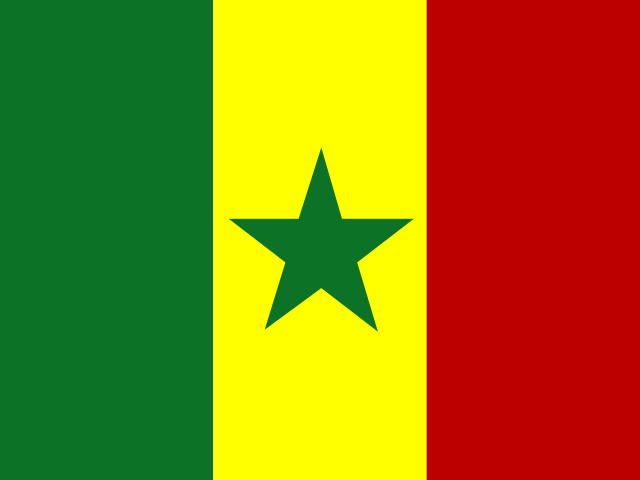
 Senegal
Comprehensive education database information
Education System in Senegal
Senegal, located at the westernmost point of Africa along the Atlantic Ocean, is bordered by Mauritania to the north, Mali to the east, and Guinea and Guinea-Bissau to the south. The Gambia partially enclaves Senegal, further enriching its geographical and cultural landscape. The nation has a population ranging from 10 to 12 million, with a literacy rate hovering around 50%. Historically, Senegal has been shaped by various empires and colonial influences, with strong ties to France evident in its language and administrative practices. The prevailing religion is Islam, practiced by approximately 94% of the population, and French serves as the official language and primary medium of instruction in educational settings. Governance of the education system falls under the purview of the Ministère de l’Éducation and the Ministère de l’Enseignement supérieur, de la Recherche et de l’Innovation.
Overview of the Education System
The education system in Senegal is designed to provide free and compulsory education to children up to the age of 16. However, various challenges hinder the full realization of this objective. The structure of the education system encompasses several levels: primary, secondary, vocational, and tertiary education.
Primary Education
- Compulsory and Free: Primary education is mandated to be both free and compulsory for children beginning at age 6 and lasting for a total of 6 years.
- Influence of Islamic Education: In some regions, traditional Islamic education may take precedence over formal schooling, complicating the enforcement of compulsory education laws.
- Challenges: Socioeconomic factors such as poverty and insufficient administrative resources hinder high enrollment and retention rates among students.
- Examinations: At the conclusion of primary education, students must successfully pass a standardized examination to qualify for advancement to secondary schooling.
Secondary Education
- Access Inequality: The secondary education landscape is marked by significant disparities, with students from wealthier families often having better access to quality institutions.
- Class Sizes: Overcrowded classrooms are a common issue, with some ratios reaching as high as 80 students to one teacher, particularly affecting students who struggle academically.
- Dropout Rates: Many students disengage from formal education, resulting in a loss of potential talent and contributing to higher dropout rates.
- Examinations: Following the first two years of secondary education, students must pass an examination that determines their eligibility to continue into the final four years of secondary schooling.
Vocational Education
- Informal Sector Engagement: Students unable to secure admission to secondary schools often seek opportunities in the informal sector, engaging in unpaid apprenticeships that can lack structure.
- Interventions: Various donor agencies are working collaboratively to establish student-centered vocational training programs, aiming to provide more formalized pathways for skill development and employment.
Tertiary Education
- Institutional Landscape: Senegal's higher education framework includes a total of six universities, comprised of three public and three private institutions.
- Gaston Berger University: Established in 1996 near Saint-Louis, it offers a diverse range of programs in both liberal arts and social sciences, alongside applied sciences and technology.
- Cheikh Anta Diop University: Founded in 1918 in Dakar, this university has evolved from an African school of medicine to accommodate over 60,000 students across various disciplines, including humanities, sciences, engineering, medicine, finance, accounting, and law, with instruction predominantly conducted in French.
Conclusion
Senegal's education system reflects both its rich cultural heritage and the contemporary challenges it faces. While efforts are underway to improve access and quality at all educational levels, addressing issues such as inequality, resource limitations, and dropout rates remains crucial for the country's educational advancement. By fostering a more inclusive and effective educational environment, Senegal can enhance its human capital and promote sustained national development.