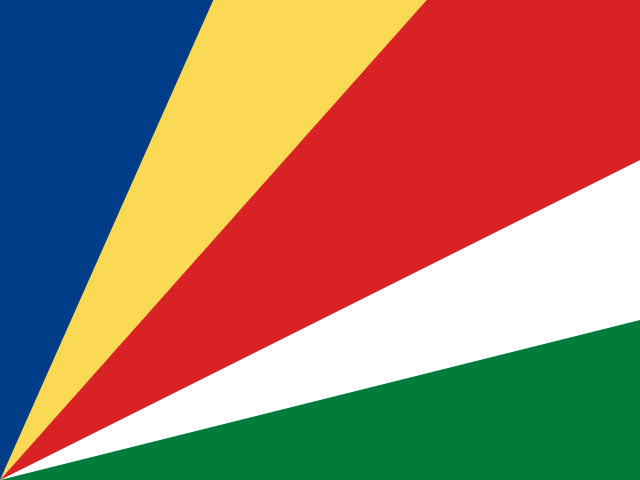
 Seychelles
Comprehensive education database information
Education System in Seychelles
Overview of Seychelles
The Republic of Seychelles is an archipelago consisting of 150 islands located in the Indian Ocean, northeast of Madagascar. With a population of approximately 82,247, the nation boasts a literacy rate of 91.8%. Although English is recognized as the official language, Creole is the most commonly spoken language among the residents. The islands were first encountered by Europeans in 1609, and they have a rich history influenced by various cultures, including those from France, Africa, England, India, and China. The French established a colony on the islands in 1756, and after a series of treaties, Seychelles came under British control in 1814. It became a separate crown colony in 1903 and gained independence on June 29, 1976. Notably, formal education in Seychelles began only in 1944, long after the islands became a British colony.
Introduction to the Education System
The education system in Seychelles is designed to provide a comprehensive 13-year compulsory education that spans from pre-primary to the end of secondary school. The system reflects the multicultural essence of the nation, with varying languages of instruction at different educational levels. The structure of the education system aims to equip students with the necessary skills and knowledge to succeed in a globalized world.
Levels of Education
Primary Education
- Compulsory Duration: Education is mandatory for children from the age of 6 until they complete secondary school.
- Language of Instruction:
- Creole is the primary medium of instruction until Grade 3.
- From Grade 3, English begins to be introduced into the curriculum.
- French is incorporated as a foreign language in Grade 6, which marks the conclusion of primary education.
At the end of the sixth year, students undertake a national attainment test that assesses their educational achievements.
Middle Education
- Structure: Middle education is provided in regional secondary schools, encompassing Grades S1 to S3.
- Challenges: A significant concern within this phase is that many students disengage from the educational process after completing the core secondary curriculum.
Secondary Education
- Continuation of Studies: Those who wish to further their education typically remain in regional schools to complete Grades S4 and S5.
- Qualifications: Successful completion of these grades enables students to qualify for:
- The National Certificate
- The Cambridge O Levels, which serve as a benchmark for academic achievement.
Tertiary Education
- Main Institution: The primary institute for tertiary education in Seychelles is the Seychelles Polytechnic, established in 1983 and located in Mahé.
- Programs Offered:
- A business and secretarial school
- A visual arts program
- Collaboration with the University of Manchester, allowing students to pursue 1st Year degree programs.
Students also have the opportunity to pursue further studies in Africa and Europe, although funding options such as bursaries for international education are somewhat limited.
Teacher Training
- Training Institutions: Teachers for primary and secondary schools receive their training at the National Institute of Education, which is part of Seychelles Polytechnic.
- Admission Requirements: Prospective teachers must have at least five passes in the GCE O-Level or IGCSE examinations to qualify for admission.
- Program Structure: Teacher training involves a two-year program leading to a Pre-Diploma, followed by a one-year program that leads to either:
- Diploma 1 in Teacher Education for primary school teachers, or
- Diploma 2 in Teacher Education for secondary school teachers.
Conclusion
Seychelles maintains a structured education system that emphasizes accessibility and quality. With its unique blend of cultural influences and a commitment to improving literacy rates, the education system continues to evolve, aiming to meet the needs of its diverse population and prepare students for future challenges.