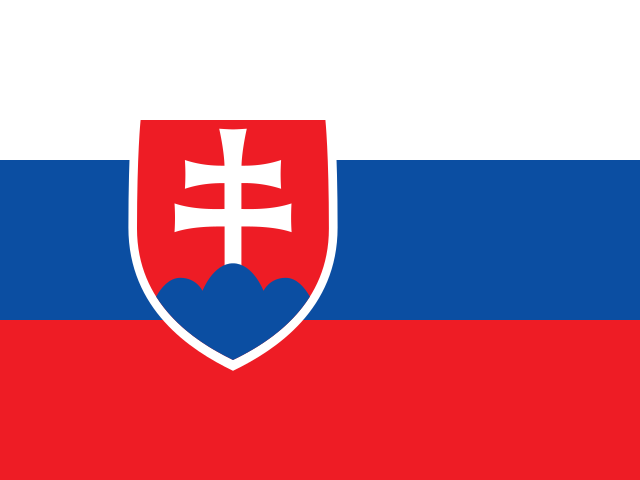
 Slovakia
Comprehensive education database information
Education System in Slovakia
Overview of Slovakia
Slovakia, officially known as the Slovak Republic, is a landlocked nation situated in Eastern Europe. It shares its borders with Poland, Ukraine, Hungary, Austria, and the Czech Republic. The country has a population of approximately 5.4 million people, boasting a remarkably high literacy rate of 99.6%. Slovakia's historical roots trace back to the Great Moravian Empire, which emerged in the late 9th century. This empire encompassed territories that are now part of several Central European nations. Following a tumultuous history that included periods of foreign rule and significant political changes, Slovakia became an independent state in 1993 after separating from the Czech Republic. Since then, it has joined international organizations such as NATO and the European Union.
Introduction to the Education System
The education system in Slovakia is well-structured and designed to provide comprehensive learning opportunities from early childhood through higher education. Education is compulsory for children aged 6 to 15, ensuring that all young individuals receive a foundational level of education. The Slovak education system is divided into several stages: primary education, middle education, secondary education, vocational education, and tertiary education. Each stage is tailored to prepare students for future academic and professional endeavors.
Structure of the Education System
Primary Education
- Mandatory Duration: Primary education in Slovakia starts at age 6 and continues until age 15.
- Foundation Phase: This phase is divided into two parts:
- First Stage: The initial four years, known as Základná Škola I. stupeň, focus on basic literacy and numeracy skills.
- Curriculum: During these years, students acquire fundamental skills such as reading, writing, and arithmetic.
Middle Education
- Continuation of Primary Education: The second part of the foundation phase is completed at Základná Škola II. stupeň, which lasts for an additional four years.
- Academic Curriculum: The curriculum is standardized and builds on the skills learned in primary education.
- Options Post-Education: Upon finishing this eight-year basic education, students can either:
- Enter the workforce directly.
- Pursue further education to improve their career prospects.
Secondary Education
- Categories of Secondary Schools: Secondary education is divided primarily into two types:
- General Secondary Schools (Gymnázium):
- These institutions provide a broad academic curriculum over four years.
- Graduates receive a secondary school leaving certificate (Vysvedčenie o maturitnej skúške).
- Specialized Institutions:
- Focus on specific fields such as technical, economic, agricultural, healthcare, or artistic education.
- Also culminate in a secondary school leaving certificate after four years.
- General Secondary Schools (Gymnázium):
Vocational Education
- Vocational Secondary Schools (Stredné odborné učilište):
- These schools offer practical vocational training as an alternative to traditional academic paths.
- Certification: Students complete four years of training and receive an apprenticeship certificate, along with additional professional qualifications.
Tertiary Education
- Higher Education Institutions: Slovakia is home to various universities and higher education institutions, offering a wide range of academic programs.
- Comenius University:
- The largest university in Slovakia, located in Bratislava, was established in 1919.
- It has a student body of over 30,000 and employs more than 2,000 faculty members.
- Faculties: The university encompasses diverse fields of study, including medicine, pharmacy, law, philosophy, natural sciences, mathematics, physics, physical education, management, and theology.
Conclusion
The education system in Slovakia is designed to provide a robust and comprehensive framework for learning, catering to the diverse needs of its population. With mandatory education for young citizens and a wide array of secondary and tertiary educational opportunities, Slovakia continues to invest in the development of its human capital, preparing students for a dynamic and evolving job market.